Monday, 12 July 2021

Rough Order of Magnitude (ROM) Vs Definitive Estimate

PMP Tutorial and Material, PMP Exam Prep, PMP Certification, PMP Learning, PMP Career, Rough Order of Magnitude (ROM)

Let’s get started.

Rough Order of Magnitude (ROM) Vs Definitive Estimate

In project management, we have different estimates to find the project budget, such as rough order of magnitude (ROM), definitive estimate, budget estimate, control estimate, final estimate, and preliminary estimate. However, the PMI recognizes only two of these: Rough Order of Magnitude (ROM) and Definitive Estimate.

As this blog follows PMI guidelines, we will discuss these two cost estimation techniques recognized by the PMI, and how they differ from each other.

ROM and definitive estimates help you find the estimate of the project at different points in time. The accuracy of these estimations depends on the quality of data available and the historical information. 

You use rough order of magnitude when little or no information is available, and a definitive estimate when you have a clearer picture.

Let’s dig deeper.

Rough Order of Magnitude (ROM)

PMP Tutorial and Material, PMP Exam Prep, PMP Certification, PMP Learning, PMP Career, Rough Order of Magnitude (ROM)

This estimate is sometimes known as a ballpark estimate. This is because it helps management or the client know the rough budget of the project. ROM typically has an accuracy range between -25% to +75%.

This estimation is done before or during the initiation phase while performing a cost-benefit analysis.

This estimate is also useful for the project selection process. 

This estimation provides you with a budget when you have very little information, or the management urgently wants to know the approximate project budget.

Once you get more information, such as the detailed scope of work, you can replace this estimate with a better one, i.e., a definitive estimate.

Tools used to Determine Rough Order of Magnitude (ROM)

To determine the rough order of magnitude (ROM), you can use the following techniques:

◉ Expert judgment
◉ Analogous estimating

In expert judgment, you look at the project and, based on your experience, come up with a figure.

In an analogous estimation, you compare the cost of the current project with any past similar projects that your organization has completed and then make an educated guess of the project on hand. You use this cost estimation technique when little or no project information is available, and the management is asking for the project cost estimate. 

Analogous estimation provides a rough order of magnitude estimate as the accuracy is not good. 

These techniques take less time, but the results are not reliable. Therefore, you use them when you require the information urgently, and accuracy is not desired.

Example of Rough Order of Magnitude (ROM)

Let us say your management wants to bid for a project that is about constructing a 20-story building, and they are interested in knowing the cost involved so they can decide if they should proceed with the bidding.

You are an experienced project manager and have handled several similar projects. You go to your organizational process assets and find a similar project. You see the estimate of the project and apply your expert judgment and come up with an estimate and provide it to your management.

Definitive Estimate

PMP Tutorial and Material, PMP Exam Prep, PMP Certification, PMP Learning, PMP Career, Rough Order of Magnitude (ROM)

The definitive estimate is sometimes known as a final estimate. The accuracy in this estimate is between -5% to +10%.

You get a definitive estimate when you have a complete scope of work. You use this technique in the planning phase. This estimate helps you determine the cost baseline, project budget, and then you can assign resources and complete your schedule.

The definitive estimate provides you with reliable data that you can trust and communicate with your project stakeholders.

Tools used to Determine Definitive Estimate

To determine a definitive estimate, you can use the following techniques:

◉ Bottom-up estimating
◉ Three points estimating
◉ Parametric estimating

These techniques are time-consuming, and you use them when you require an accurate budget.

The estimation obtained from the bottom-up estimation technique is the most accurate, and that is why this technique is also known as the “definitive estimation technique”.

Here, you find the cost of each activity and add them up to get the project’s cost. This technique is time-consuming but provides the best result.

In three-point estimating, you find three estimates (optimistic, pessimistic, and most likely) and take an average.

The estimations obtained from three-point estimating and bottom-up estimating are most accurate. 

In parametric estimation, you use statistical data from any past projects and apply it to the current project parameter—for example, the painting cost per square meter.

The accuracy of parametric estimation is better than analogous estimation. The accuracy can be more accurate depending on the quality of data and the effort involved.

Example of Definitive Estimate

Let us consider the same example discussed in the case of ROM.

Your organization gets the project, and now they want the exact project cost to assign the project budget and start the project. So you break down the work to the activity level, assign resources, and effort, and find the cost of each activity. Once you get it, you add the cost of all activities and get the project budget. 

You have used the bottom-up cost estimation technique here, and it provides the most accurate budget estimate. 

Source: pmstudycircle.com

Saturday, 10 July 2021

Best PMP Exam Simulator 2021

PMP, PMP Certification, PMP Exam, PMP Prep, PMP Tips, PMP Preparation, PMP Career

In this blog post, I will provide you with a few of the best PMP exam simulators that you can use for your PMP exam preparation.

The simulators have an important role in the PMP exam preparation. They provide you with PMP exam sample questions and simulated tests.

The PMP sample questions let you practice the questions. They help you build your understanding of the concepts and develop logical reasoning.

Simulated tests let you check your readiness for the real exam. The duration of the PMP exam is 230 minutes. Attempting 180 questions continuously is not easy, therefore you need to practice a lot. 

These simulators help you practice the simulated tests, and you can build your stamina. They will make you ready to sit the exam and attempt the questions.

These tests will find your weak spot, so you can work on improving your performance.

Without further delay, let us get started.

PMP Exam Simulator

If you are in a hurry, here are my top favorite PMP Exam Simulator with a click-through link:

1. PMP Exam Simulator by Cornelius Fichtner

2. PM Fast Track by Process News

3. PMP Mock Test

4. PMP Question Bank

Now, we will discuss them in detail.

#1. PMP Exam Simulator by Cornelius Fichtner

The PMP Exam Simulator by Cornelius Fichtner is the most popular PMP exam simulator and is used by thousands of PMP aspirants to pass the PMP exam.

The famous PMP trainer, Cornelius Fichtner, is the developer of this exam simulator. 

This PMP exam simulator has more than 2,100 practice questions, including five simulated tests. Each simulated test has 180 questions.

A few features of this simulator are:

◉ High-quality PMP exam sample questions

◉ Five Simulated exam tests

◉ Detailed explanations

◉ Different learning modes (Exam, Timed, Learning)

◉ Unlimited attempts

◉ Live Feedback

With the live feedback option, you can ask for help directly from the question window, and an expert will respond to you with an explanation.

Other than practice questions, this PMP exam simulator provides five bonuses:

1. A five-email course on PMP exam strategies to learn how to take the exam. 

2. Access to an active discussion forum supported by 12 PMP-certified moderators.

3. A sample exam score worksheet to help you keep track of your performance and find your knowledge gaps.

4. A contact hours worksheet to help you keep a record of your contact hours so you can easily report to PMI while filling the exam application form.

5. Weekly exam tips newsletter to provide you weekly tips, tricks, study strategies to help you prepare for the PMP exam. 

PMP exam simulator has useful analytics, and it provides in-depth data on your exam preparation. I have not seen such detailed information on any other PMP exam simulator.

You can compare your performance against other students and find where you stand. You can track your progress by domain or topic wise. This helps you find your weak spot. 

The price of the PMP Exam Simulator is 149 USD, and the access is for 90 days. This PMP exam simulator is updated with the latest exam content outline applicable from the 2nd January 2021.

Click here to subscribe to PMP Exam Simulator

#2. PM Fast Track by Process News

This is another popular PMP exam simulator developed by world-famous PMP trainer Process News. Unfortunately, she is no longer with us, but her team actively manages the product.

The product is available at 299.00 USD and is the most expensive PMP exam simulator on this post.

A few features of this simulator are:

◉ Over 2,000 PMP exam sample questions

◉ Simulated tests within a real exam environment, including the rest

◉ Study modes to take exams by Domain, Process Group, Knowledge Area, or Keyword

◉ Cloud-based access

◉ Cross-referenced to Process PMP Exam Preparation book

◉ Full exam history to check to find your knowledge gaps

◉ Available in Spanish and Portuguese

Click Here for More Details

You can select any one of the above PMP exam simulators. I recommend you go for the PMP Exam Simulator by Cornelius Fichtner, as it has more in-depth analytics and live community than Process Fast Track.

Also, Cornelius’s Simulator is much cheaper than Process Fast track.

#3. PMP Mock Test

This is a timed simulated test with a duration of 230 minutes. This test is priced at 4.99 USD and is the most affordable PMP exam simulator test.

The content is based on the latest exam content outline, and it covers situation-based questions, formula-based questions, interpretation-based questions, etc.

This simulated test has multiple choice questions with a single response, multiple responses, and fill-in-the-blank questions.

Many successful students have taken this test, and questions have been reviewed and validated multiple times.

The access is immediately after the payment, and the access duration is three months. You can attempt the test unlimited times.

Click here for More Details

#4. PMP Question Bank

I have developed this question bank to provide PMP aspirants a set of high-quality PMP exam sample questions with affordable pricing.

This is not a simulator, but an eBook that has two sets of 180 PMP exam samples questions, i.e., 360 questions in total, and is aligned with the latest exam content outline applicable from the 2nd January 2021.

This eBook is available in three formats: pdf, Mobi, and ePub, so you can use them on any device you own.

The price of this PMP Question Bank is 4.99 USD, and the access is instant.

Click here for more details.

This eBook comes with a 30-day money-back guarantee. If you don’t like the product, you can ask for a refund. Refund is immediate with no question asked policy, and you can keep the eBook.

A Few Tips on buying PMP Exam Simulator

◉ Ensure that it is aligned with the latest exam content outline. The current exam content outline is applicable from 2nd January 2021.

◉ It should have a no-questions-asked money-back guarantee.

◉ It should be from a renowned provider with a solid track record.

Source: pmstudycircle.com

Friday, 9 July 2021

Beyond the board: How Kanban works within agile

Prince2 Exam Prep, Prince2 Preparation, Prince2 Exam, Prince2 Certification, Prince2 Learning, Prince2 Guide

Kanban is a system for managing the flow of work. Developed in the 1940s, the system was originally designed to improve manufacturing efficiencies by tracking production. Surprisingly, when Kanban first started out, there was no visual board at all. It was a foundation of principles that made the Kanban system.

More Info: PRINCE2 Practitioner

Despite the common belief that Kanban is a board for tracking work, it is in fact the foundation of principles that are core. The board is a great visual aid to show you what is happening, but the principles are what make the system. The principles envelop the six rules of Kanban – a topic we have covered before in the PRINCE2 blog. These have been developed further over the years as Kanban has been adopted by a range of industries, from project management to IT development, sales and marketing to QA and testing.

In a recent podcast interview, CEO and founder of Kanbanize, Dimitar Karaivanov talks of the evolution of Kanban -

“In 2018, I believe it was, we had the publishing of the Kanban Maturity Model, which is a whole new body of knowledge that maps all the Kanban practices across six maturity levels. And now, apparently, we have more than 150 Kanban practices.”

Its expanding diversity of uses allows Kanban to be used across almost any industry, and hand in hand with other frameworks such as agile.

Kanban and Agile - a perfect pairing

Agile practice is the ability to create and respond to change. At PRINCE2 we offer training to become PRINCE2 Agile certified, an accredited course which combines the flexibility of agile with the framework of PRINCE2. Within the course, you will learn key agile principles which allow for continuous delivery and adaptability.

The agile manifesto outlines that:

◉ individuals and interactions should be valued over processes and tools

◉ working software over comprehensive documentation

◉ customer collaboration over contract negotiation

◉ responding to change over following a plan

Much of this manifesto works cohesively with the principles of Kanban. For one, the focus of Kanban is on individuals and interactions. Delivery is a priority but not at the expense of overloading team members. As is the case within agile, Kanban sees the team as the most important figure in the process.

Take for example, the issue of blockers. Blockers in Kanban are unforeseen factors which cause delays for a task on your board to progress forward. In this situation, individuals will ‘swarm’ on the blocker, even if it means stepping outside their area of expertise, as a proactive way of problem solving. This interaction is also evidence of collaborative practices being commonplace in Kanban, just as they are in agile. The work queue and managing the flow are shared responsibilities.

Those working in agile environments value working software, and likewise Kanban is mostly used in digital, interactive forms, usually as a board. Typically, there will be columns which represent the state of the task. When a task is finished by a team member, it is pulled to the next column by the person who will complete the next task. For example, pulling from ‘programming’ to ‘testing’. Various software applications are available for creating Kanban boards, and within agile working this becomes an invaluable resource.

Further parallels can be drawn in that Kanban often entails daily Kanban meetings, much like daily scrums, though the format of these is more focussed on solving workflow issues and overcoming any blockers. Kanban also promotes having risk review meetings and service delivery reviews; and it values metrics. Its transparent, collaborative framework for working means that Kanban and PRINCE2 Agile work together seamlessly.

Responding to change over following a plan

Arguably one of the biggest things agile and Kanban have in common is prioritising responding to change, over following a plan. Kanban offers a structure for working flexibly, and in that way, it mirrors PRINCE2 Agile. Getting things done is a process, but plans need to be adaptable. Kanban is all about visualizing your work, limiting work in progress, and maximizing efficiency. It involves planning, execution, iteration, and reflection.

Change can happen at any time, and by recognising this, Kanban allows for agility. Daily meetings or ‘feedback loops’ are key to the Kanban practice as they advance collaboration and develop innovative, experimental practices. Agility and innovation are vital in order to harness change, as well as for identifying opportunities for progression.

Agile and Kanban both have incremental delivery and continual development at their heart, whilst always being focussed on the bigger picture. Kanban encourages teams to learn and improve continuously as part of its value-centric approach. All the while, it continuously eliminates waste and removes obstacles.

Prince2 Exam Prep, Prince2 Preparation, Prince2 Exam, Prince2 Certification, Prince2 Learning, Prince2 Guide

“Start from where you are at now and constantly look to inspect and improve.” - [Source]

But Kanban isn’t just for teams. The project manager should be heavily involved in feedback loops and in the board, flow, and metrics. They should utilise this information to feedback and communicate with senior management as well as stakeholders. In that way, Kanban works within agile both in daily practice and when strategizing and addressing the wider picture.

The Kanban system is increasingly used within project management and features in the PRINCE2 Agile guidance. To find out more head to our PRINCE2 Agile course page.

Source: prince2.com

Wednesday, 7 July 2021

PMP Exam Preparation: Pass the PMP Exam on Your First Attempt

PMP Exam Preparation, PMP Tutorial and Material, PMP Study Material, PMP Career, PMP Exam Prep, PMP Learning, PMP Learning, PMP Guides

In today’s blog post I will explain in detail about the PMP exam preparation. I believe if you follow the strategy given in this post, you will be in a better position to pass the PMP exam on your first attempt.

Over the last ten years, I have seen many aspirants pass and fail the PMP exam.

Professionals who prepare for the PMP exam the right way passed the exam on their first attempt, while others with a casual approach failed it.

The correct PMP exam preparation strategy is the first step toward attaining this prestigious certification.

I believe you fulfill the PMP requirements and are in the initial stage of your PMP exam preparation.

PMP Exam Preparation

The right PMP exam preparation requires the following steps:

1. Gather Information

2. Collect Study Resources

3. Start Preparation

4. Join the PMP Training

5. Apply for the PMP Exam

6. Attempt the Test

Gather Information

Gather all information related to the PMP certification. In the recent past, PMI has made many changes to the PMP certification exam. A few examples of these changes are the addition of Agile and Hybrid project management, updates to the exam content outline, scheduled breaks during the exam, etc. 

They also changed the question type. Before January 2, 2021, the exam had multiple-choice questions with a single response, but now the exam has four different types of questions:

◉ Multiple choice with single responses

◉ Multiple choice with multiple responses

◉ Fill in the blanks

◉ Answer selection

However, if you search on Google for the PMP exam preparation, you will find that most resources are not updated and if you trust them, your PMP exam preparation may go sideways.

You must have the right information.

Download the PMP Handbook from PMI.org and read it thoroughly. You should only rely on this official document. After reading this guide, you will have the answers to most questions related to the PMP exam process.

After reading the PMP Handbook, you should review the latest PMP exam content outline. 

Collect Study Resources

You should have the right and high-quality PMP exam study resources for your exam preparation. Using low-quality resources will harm your PMP exam preparation, and you will be under the false illusion that you are preparing well.

I recommend you use the following resources for your PMP exam preparation:

◉ The PMBOK Guide

◉ The Agile Practice Guide

◉ Rita’s PMP Exam Preparation Book

◉ Head First PMP

◉ PM Sprout’s PMP Training Program

◉ The PMP Exam Preparation Tool

◉ PMP Question Bank

◉ The PMP Mock Test

◉ PM Exam Simulator

These resources are enough for your PMP exam preparation.

You must read the PMBOK and Agile guide. Understanding these guides will help you answer many questions. Head First and Rita’s books are the best books for the PMP exam, and these will help you understand all concepts.

If you opt for the PM Sprout PMP training program, you won’t have to buy the PMP exam preparation tool, PMP Question Bank, or the PMP Mock Test, as these all are included in the PM Sprout PMP Training Program.

The PMP Exam Simulator by Cornelius Fichtner is the best PMP exam simulator and provides you with over 2,100 PMP exam practice questions.

Start the PMP Exam Preparation

Start with reading the Head First PMP book. Once you are finished, reread this book, cover to cover.

Then you can move on to Rita.

Now you can read the PMBOK Guide and Agile Practice Guide. Read these guides until you understand all project management processes and agile fundamentals.

If possible, form a study group. Attend meetings for your local chapter and find other PMP aspirants and ask them to form a PMP study group. Through joint study, you can learn from each other’s knowledge and experiences and share your knowledge.

Sharing knowledge will make you more confident. It will motivate and push you to study regularly.

Join a PMP Training Program

I have seen many aspirants join the PMP training at the very beginning of their PMP exam preparation. This is not the best strategy. If you start the training without doing your homework, you will not get the most out of it.

You should know what the training provider will teach you. Reading reference books and the PMBOK/Agile Guide will help you prepare for the PMP training.

You should join an online PMP training program as they are affordable, and you can complete it at your own pace.

I recommend you join the following  Try Online Exam.

PM Sprout PMP Training Program

This PMP training program is a complete exam preparation package and provides a variety of content. No other competitor or online training program offers such a package.

This training program includes:

◉ Video Sessions

◉ Study Notes

◉ True/False Statements

◉ Flashcards

◉ PMP Question Bank

◉ PMP Formula Guide

◉ PMP Mock Test

If you subscribe to this training course, you don’t have to subscribe to any other study resources (except the PMP Exam Simulator); it includes everything.

However, if for any reason you cannot subscribe to the PM Sprout Training Program, I advise you to subscribe to the PMP Exam Preparation Tool.

This tool includes everything given in the above list, except the video sessions.

Apply for the PMP Exam

This is important.

You should immediately apply for the PMP exam after completing the PMP training. I have seen many professionals delay the PMP exam application process after completing the training and then they lose interest. They waited for the right movement; they thought they will apply for the exam when they are ready, and that moment never comes, and they slowly lose interest in becoming a PMP.

Schedule the PMP exam as soon as you get your 35 contact hours certificate.

Usually, three months’ time is enough for the PMP exam preparation. If you have spent two months of rigorous PMP exam preparation, I suggest scheduling the date for one month later.

Once you schedule the date, you will notice that you are more motivated and your studies are more punctual. You will see your hidden potential.

This all happens once you set the schedule.

Note that now you can attempt the exam from your home as well. However, if the test center is available in your city, I suggest you attempt the exam from the test center and not go for the home option.

Choose home proctoring only if the test center is not available in your city or you cannot go to the test center. Proctors are tough on exams that are conducted at home. Also, if your computer turns off, the camera stops working, or the computer lags, they may terminate your test even though it is not your fault.

Choose the home proctoring option carefully.

Practice these sample PMP questions, find your weak spots, and fill your knowledge gaps. Practicing PMP exam questions is an important stage in your PMP exam preparation. Don’t skip difficult questions. Work on them and understand the concepts.

In the PMP exam, you will see a few mathematical questions. If you are having issues with solving mathematics, I recommend you use my PMP Formula Guide, which is a comprehensive book for PMP math. I assure you after completing this book, you will be in a much better position to solve mathematical questions in the PMP exam.

When the exam date is near, you should start trying mock tests. These mock tests can be from:

◉ PMP Exam Simulator

◉ PMP Mock Test

◉ PMP Question Bank

Attempting these mock tests will build your stamina and confidence.

Attempt the Test

Now we come to the final stage of your PMP exam preparation.

If you are attempting the test from the test center and don’t know the location, visit the center a day before the exam. This will help you save time and stress finding the correct location on the day of the exam. 

Reach the center at least half an hour before the exam so you can complete the formalities. Once you complete the formalities, you will be taken inside the examination hall and your test will begin.

Note that before the exam, you have to go through an awareness session, which has a 15 minute duration. This time is not added to the exam time. Take your time to follow this tutorial.

The duration of the PMP exam is 230 minutes, and it has 180 questions, including five pretest questions. The marks of these pretest questions are not added to your score because they are used in exams as an effective and legitimate way to test the validity of future PMP exam questions. These pretest questions are randomly placed, and you cannot discern if a question is real or a pretest questions.

Therefore, consider all 180 questions real questions.

The exam has three sections and two 10 minute breaks. The first break will appear after you complete the 60th question and review all the answers. You will get the second break after you have completed question 120 and reviewed the answers. 

Understand that you cannot review the questions from the previous section once you review your responses and start your break. 

After the break, you can use the remaining time to complete the final section. The total time is 230 minutes to answer 180 questions. 

The exam is preceded by a tutorial and followed by a survey. These are optional and can take 5 to 15 minutes to complete. The tutorial and survey time are not included in the exam duration.

PMP Exam Preparation, PMP Tutorial and Material, PMP Study Material, PMP Career, PMP Exam Prep, PMP Learning, PMP Learning, PMP Guides

Complete the tutorial and note down important concepts on paper that you find difficult to recall. These concepts can be mathematical formulas or any information points.

Afterward, you can start answering questions.

Start by solving easy questions; if you get stuck on a question, skip and mark it for later review. Once you complete the section, revisit these questions and give yourself another chance to answer. 

Do not leave any answers blank. The PMP exam has no negative marking, so answering those questions will give you at least a 25% chance of being correct. 

If you still have some time after you have answered all questions, I recommend you review the answers. You may find some click errors. I remember I found a few wrong selections even though I knew the correct answers. It happened because I unknowingly clicked on the wrong answer.

Don’t make haste in the final submission. You won’t get this moment again. Use all the time allotted to you and then submit the answers.

After submitting the answers you have to complete a survey and then you will see your result.

I wish you get a congratulatory message.

Once you pass the PMP exam, you will get a printout of your result. Within ten days, you will receive a congratulatory message from PMI, and then you can see your result in your PMI account. 

Until your results show in your PMI.org account, you can see your results on the PearsonVUE site. Then, within four to eight weeks, you will receive your PMP certificate.

Source: pmstudycircle.com

Monday, 5 July 2021

10 Popular Project Management Methodologies

Project Management Methodologies, Project Management Exam Prep, Project Management Preparation, Project Management Career, Project Management Study Material, Project Management Certification

Project management methodologies have essential roles in how you govern your project. Until a few years back we used to have one popular project management methodology, which is the traditional project management methodology or waterfall.

This methodology was useful for construction types of projects where you have a well-defined scope; however, IT projects had trouble with this project management approach because these projects had continuous changes and the waterfall method was not suited for projects with changing requirements. 

So project managers needed new methodologies to help deal with changing requirements. Consequently, Agile methodologies came, and afterward, many more new more project management approaches followed. 

In today’s post, I will introduce you to ten popular project management methodologies.

Project Management Methodologies

A project management methodology is a set of guidelines and best practices that help you to complete your project efficiently with less obstruction.

Every project is unique and you need the right methodology for your project.

The project management framework evolved from a traditional approach to Agile, resulting in significant changes in the way we carry out the project activities. 

Project management approaches affect the culture of the organization and the project team. You need to understand the culture to work seamlessly with your team. 

Here are the top ten project management methodologies used by organizations to complete their projects:

1. Waterfall

2. Scrum

3. Disciplined Agile

4. SaFE (Scaled Agile Frameworks)

5. DSDM (Dynamic Systems Dev. Method)

6. LeSS (Large Scale Scrum)

7. Scrum of Scrum (SoS)

8. XP (eXtreme Programming)

9. Kanban

10. Lean

#1. Waterfall

This is the most popular project management methodology. Here you have a well-defined scope and activities are planned in sequence. You invest a lot of effort into collecting requirements and then developing the project management plan. Once all plans are developed, baselines are created, you get them approved and follow them religiously.

Changes in the project management plan or baseline are not easy. All change requests go through a lengthy process to get approved. After the approval, you will update your plans and baselines.

Changing requirements in this project management approach are difficult and costly. All change requests go through a time-consuming change management process. 

Project Management Methodologies, Project Management Exam Prep, Project Management Preparation, Project Management Career, Project Management Study Material, Project Management Certification
Time and Risk Increase WIth Progress

The waterfall methodology is impracticable for a dynamic environment where requirements keep on changing. 

The scope in a waterfall is fixed, unlike Agile where changing customer needs is built into the methodology. Feedback in agile is continuous, whereas, in the waterfall method, it’s at the point of validating scope. You can miss defects during the product development, and correcting them at a later stage will be time-consuming and costly. 

But in Agile, changes are part of the framework. Customers can request changes at any time, and finding defects is easier because of frequent demos.

In waterfall, quality control activities are carried out throughout the execution phase, unlike test-driven Agile projects where you build in quality with automated testing as the project progresses.

The waterfall method is suitable for well-understood projects with stable requirements.

#2. Scrum


Scrum is one of the most popular Agile methodologies. It guides the team on iterative and incremental product development. 

While a traditional project management methodology works with fixed requirements and optimizes around time and cost, Scrum, on the other hand, fixes time (via time boxes) and cost (via prioritizing the product backlog for a potentially shippable delivery) to optimize changing customer requirements through collaboration and frequent feedback. 

Scrum is an adaptive methodology to develop the desired product.

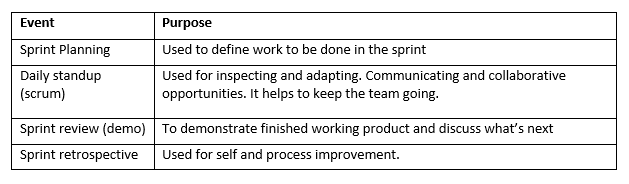
Scrum Events
Project Management Methodologies, Project Management Exam Prep, Project Management Preparation, Project Management Career, Project Management Study Material, Project Management Certification

Scrum Roles 

Project Management Methodologies, Project Management Exam Prep, Project Management Preparation, Project Management Career, Project Management Study Material, Project Management Certification

N.B.: The sprint is a time-boxed activity to complete the work. The sprint ends with a sprint review and then a retrospective. The product backlog may change, but once the sprint is planned, any new feature is sent to the product backlog and prioritized for the next sprint. A sprint normally lasts two weeks.

During the sprint, daily standups last for 15 minutes where each member tells the team what they did yesterday, what they plan to do today, and what is getting in their way. This is where the scrum master removes impediments.

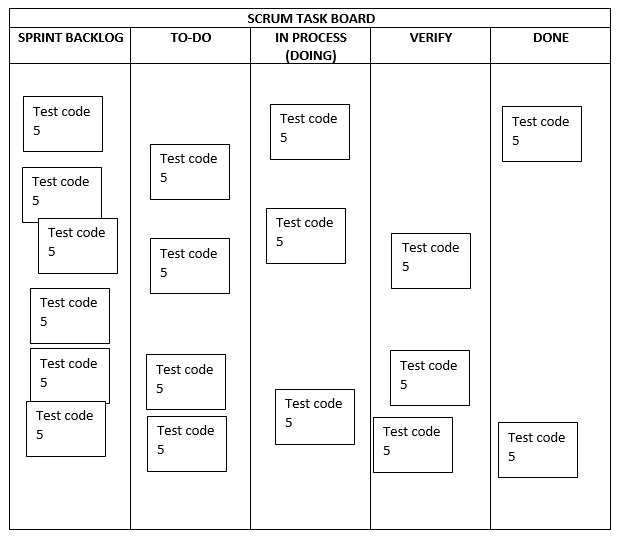
How does the scrum track progress in a sprint? 

The team uses visible information radiators such as burndown charts and task boards to track the progress.
Project Management Methodologies, Project Management Exam Prep, Project Management Preparation, Project Management Career, Project Management Study Material, Project Management Certification

#3. Disciplined Agile


This is an upgraded version of Agile. It combines the freedom of choice and suitability with proper guidance on narrowing choices. It is characterized by the freedom to choose your way of working (WoW). 

Disciplined Agile is context-dependent. It is about tailoring what works for you. It blends Scrum, SaFE (Scaled Agile Frameworks), Traditional (waterfall) approach, Kanban, eXtreme Programming, etc. It is an Agile optimization tool that can be used to extend agility from the team to the organizational level. 

It accelerates value delivery, which can help customers test the product in the market quickly.

The Disciplined Agile (DA) has seven principles:

Project Management Methodologies, Project Management Exam Prep, Project Management Preparation, Project Management Career, Project Management Study Material, Project Management Certification

1. The choice is Good: You have to choose the best-fit technique for your processes/situation. You have to understand all choices and trade-offs of selecting a particular choice. 

2. Delight Customers: The customer is the center of everything, whether internal or external. You have to make them happy. If you don’t delight them, someone else will and the customer will move elsewhere.

3. Be Awesome: Be awesome with what you do. If you are awesome, the client will love working with you.

4. Pragmatism: It implies doing what works, not what is usual. If something works best even in a traditional project approach, adopt it. Be as effective and efficient as possible.

5. Optimize Flow: Continuous flow of task/work by using Kanban. Your organization may have a complex flow system but you have to adapt to it. Ensure that communication is smooth between your team and the organization or even within different teams in your organization.

6. Context Counts: We all are unique and so is the organization’s culture. Understand the context and evolve with an effective strategy for the situation you face.

7. Enterprise Awareness: Ensure that the team is aware of their organization. It motivates them to align with the organization’s objectives and they will contribute to achieving larger goals.

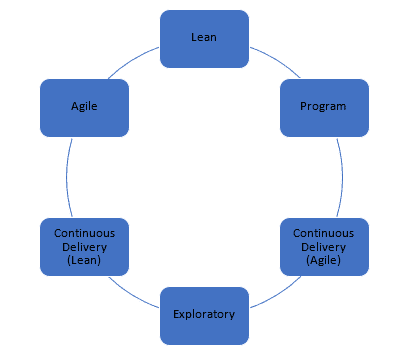
DA uses six different life cycles, the life cycles are:
Project Management Methodologies, Project Management Exam Prep, Project Management Preparation, Project Management Career, Project Management Study Material, Project Management Certification

You can choose the best fit for your needs.

DA’s process tailoring workshops help your team understand the importance of working together. It includes selecting a lifecycle, walking through the process goals one at a time, addressing the decision points, and deciding roles and responsibilities.

DA has four phases: Inception, Construction, Transition, and Deployment. 

As shown in the table below, these phases have 21 process goals:

Project Management Methodologies, Project Management Exam Prep, Project Management Preparation, Project Management Career, Project Management Study Material, Project Management Certification

Each process goal links to a decision point that further branches to various ways of achieving the goal. 

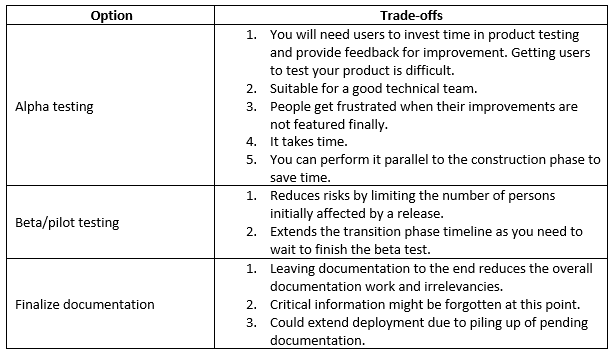
For example, assume you want to ensure production readiness.

Project Management Methodologies, Project Management Exam Prep, Project Management Preparation, Project Management Career, Project Management Study Material, Project Management Certification

DA believes business agility comes from freedom, not frameworks. So, it combines all known frameworks such as Lean and Scrum to eXtreme Programming and provides you with choices to select and deliver the consumable solution (not working software) to the market quickly. 

Disciplined Agile helps you choose the best agile solution for your situation.

While Agile produces working software, DA produces a consumable solution. A consumable is a usable product that is ready to be deployed to the market.

In summary, Disciplined Agile deals with decisions you need to consider, the options available to you, and the trade-offs associated with these options. You make your choice.

This helps products get released to the market sooner.

Further on the example above, let’s consider the trade-offs for each option.
Project Management Methodologies, Project Management Exam Prep, Project Management Preparation, Project Management Career, Project Management Study Material, Project Management Certification

#4. SaFE (Scaled Agile Frameworks)


Here you take the lean and Agile approach from team level to enterprise level. It is about transition and bringing different agile teams together. To avoid challenges, large framework implementation requires a systematic approach to incorporate best practices. 

SaFE helps in organizing several agile teams. Large companies like Microsoft and Ericsson have adopted the scaled agile approach. 

Before we discuss SaFE any further, let us understand Agile methodology.

Agile methodology is flexible compared to traditional project management methodology and adapts to changing needs against a pre-planned approach. It provides customers with a minimum viable product (working software) as early as possible. 

Agile is iterative and allows changing needs and dynamic environment realities. It breaks functional silos and pulls talent from each function into teams to achieve collaboration and coordination. 

If your organization is intending to scale agile from team to enterprise-level, they must assess the fitness level of the team and its culture, including:

◉ Leaders with clear vision.
◉ Changes are welcomed and must be anticipated.
◉ Time and cost are fixed, but the scope is flexible.
◉ Stakeholders’ interest in working software components.
◉ Active customer participation.

The above conditions are typical agile requirements. Since the organization is adopting an agile approach, the team’s mindset must be agile to follow an agile framework.

Choosing an agile framework to scale depends on some factors, such as:

◉ The number of agile teams in the organization.
◉ The company strategy and the impact of agile practices.
◉ Average size and complexity of agile projects.
◉ Critical success factors for the transition.

These factors are better described in the ten principles of SaFE, which are:
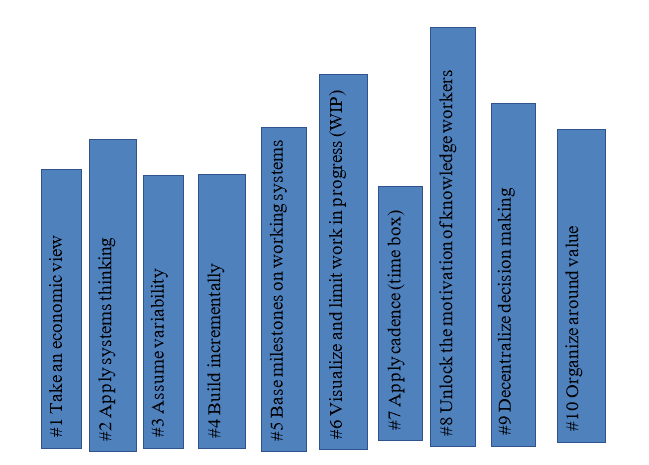
Project Management Methodologies, Project Management Exam Prep, Project Management Preparation, Project Management Career, Project Management Study Material, Project Management Certification

SaFE pioneered the Agile Release Train (ART) concept to organize teams around a value stream. They align teams (remember, scaled agile deals with several agile teams) to a shared business objective. A value stream is a set of actions that create customer value. 

The term train is used to show interconnection. The figure below shows agile teams 1, 2, and 3 aligned on a value stream for a desired solution/feature.

Project Management Methodologies, Project Management Exam Prep, Project Management Preparation, Project Management Career, Project Management Study Material, Project Management Certification

T1, T2, and T3 are agile teams, while S-is the solution or the value. The value stream is the movement from design through build, test to deploy.

The value stream is common in both Agile and lean. It is a set of actions that create customer value. SaFE provides enterprise agility that enables portfolio, program, and project (execution) teams to release a product to the market rapidly.

Some roles in SaFE are:

Project Management Methodologies, Project Management Exam Prep, Project Management Preparation, Project Management Career, Project Management Study Material, Project Management Certification

#5. Dynamic System Development Method (DSDM)


Agile and Kanban are subsets of lean and DSDM. DSDM is a framework applicable to constraint-driven projects where constraints such as cost, time, and quality are fixed, while scope (functionality/features) can change.
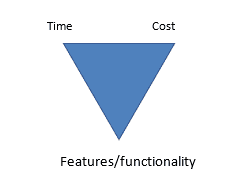
Project Management Methodologies, Project Management Exam Prep, Project Management Preparation, Project Management Career, Project Management Study Material, Project Management Certification

Its principles comply with agile such as collaboration, continuous and clear communication, iterative development, and delivery on time. 

DSDM has eight principles:

1. Focus on the business needs. Every project decision must be in sync with high-level business value.
2. Deliver on time-timebox project tasks, focus on business priorities.
3. Collaborate and build a one-team culture for increased understanding, greater speed, and shared ownership.
4. Never compromise quality. Test early and continuously. Agree with the quality level from the outset.
5. Build incrementally from a firm foundation. This implies that a good understanding is required before building a solution.
6. Develop iteratively to embrace changes from feedback.
7. Communicate continuously and clearly. Aim for honesty and transparency in all communication.
8. Demonstrate control-make plans and projects visible to all using, for example, Gantt charts and task boards.

Roles in DSDM
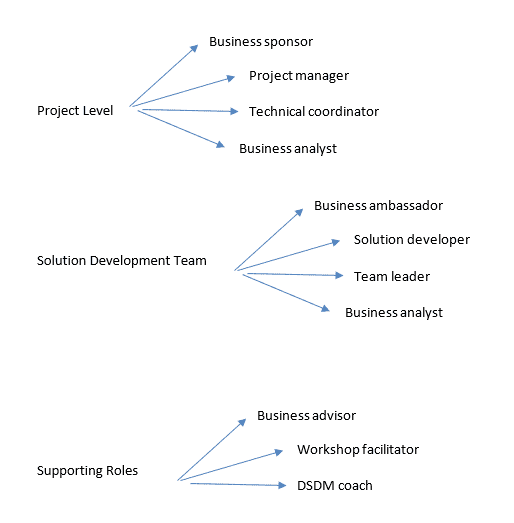
Project Management Methodologies, Project Management Exam Prep, Project Management Preparation, Project Management Career, Project Management Study Material, Project Management Certification

DSDM facilitates workshops. This helps engage stakeholders in solving a problem or developing a plan. The business owner, team lead, etc., can request this workshop.

The workshop is moderated by a neutral individual called the facilitator. The neutrality of the facilitator is important for a better outcome or workshop.

#6. Large Scale Scrum (LeSS)


LeSS is scrum extended to different scrum teams. It is a scrum applied to large-scale development. Here you still retain the basic attributes of a scrum, such as: 

◉ Teams work on their sprints concurrently.
◉ One product owner handles the team.
◉ Teams are co-located.
◉ The teams work with one definition of done.
◉ One potentially shippable product from all the teams.
◉ One sprint for all.
◉ One product backlog for all, but each team has its own sprint backlog.

LeSS Principles

◉ Systems thinking: Everyone in the organization should focus on the whole product. They should know that there is no value in separate parts but integrated parts. It helps break silos, has a long-term team view, finds root cause solutions, and has fewer impediments. The team needs to understand the impact of their actions on the surrounding environment.
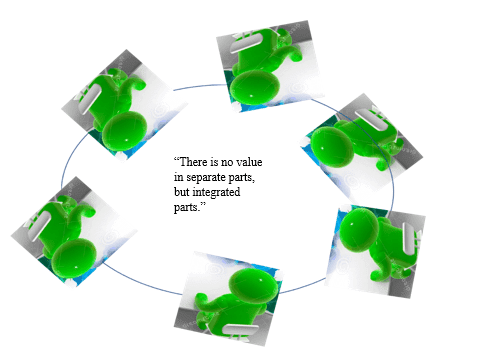
Project Management Methodologies, Project Management Exam Prep, Project Management Preparation, Project Management Career, Project Management Study Material, Project Management Certification

Other principles are

◉ Transparency 
◉ Customer-centric
◉ Lean thinking
◉ More with LeSS (Large Scale Scrum)
◉ Continuous improvement
◉ Queuing Theory (reducing batch sizes to shorten delivery time)
◉ Empirical process control

#7. Scrum of Scrum


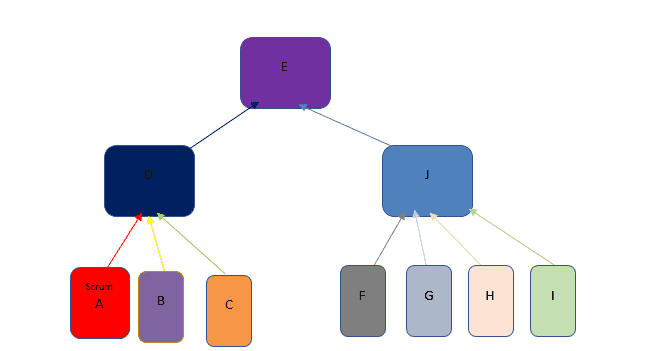
This project management methodology is useful when work from several scrum teams needs to be coordinated. Representatives from each scrum meet to coordinate their work. These representatives are referred to as “Ambassadors.” 

The meeting is similar to the daily stand-up meeting where each representative reports completed work, the next assignments, and impediments. This meeting (Scrum of Scrums) aims to ensure smooth coordination of work. 

This Scrum of Scrum can further extend to the Scrum of Scrums of Scrums depending on project size; the principle for coordination is the same.  

Scrum of Scrum is also called meta-scrum. The duration of a scrum meeting is about 15 minutes. This is still retained at the Scrum of Scrum meetings.
Project Management Methodologies, Project Management Exam Prep, Project Management Preparation, Project Management Career, Project Management Study Material, Project Management Certification

A, B, and C are scrum teams with one ambassador attending D, a Scrum of Scrums.

Similarly, J is the Scrum of Scrums of scrum teams F, G, H, and I.

The ambassadors of Scrum of Scrums D and J meet at E, Scrum of Scrums of Scrums.

It helps to ensure that the scrum teams fit together and operate cohesively.

#8. Extreme Programming (XP)


It started in 1996 when Chrysler Corporation embarked on a payroll restructuring program, the C3 (Chrysler Comprehensive Compensation) system. Their development team adopted a way of working that metamorphosed into Extreme Programming. 

Extreme Programming (XP) has an agile mindset based on values, principles, and ways of working. XP is the foundation of excellent software development.

This is like refining, where you aim to get the purest product. Quality is at its peak. It requires repeated cycles of testing and refactoring.

The core values of Extreme Programming are Communication, Courage, Respect, Simplicity, and Feedback.

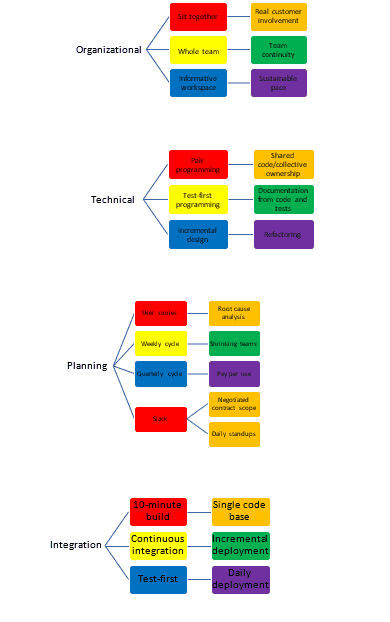
Extreme Programming has four practice areas: organizational, technical, planning and integration. These areas require primary practices, which are necessary for secondary (corollary) practices. 

In the figures below, the practice areas are depicted with their corresponding primary and corollary practices. Red, yellow, and blue (primary colors) represent the primary practices, while secondary colors (orange, green, purple) represent the corollary practice.
Project Management Methodologies, Project Management Exam Prep, Project Management Preparation, Project Management Career, Project Management Study Material, Project Management Certification

The primary practices must be in place before you implement secondary practices.

For example, with no pair programming, it will be difficult to have a shared code/ownership mindset. 

The workspace for Extreme Programming must have visual aids such as flip charts or task boards to communicate status and progress. 

You should maintain the workload of the team to avoid burnout. They should not work more than 40 hours per week.

Slack helps in planning to avoid delays because of unlikely events. It is a set of minor activities built into the planning to meet the deadlines.

Small projects have a higher success rate. So, XP recommends incremental delivery. Break down the huge mass into manageable increments of small but regular releases with only the required functionality. Release time is between 2-4 weeks. 

Simplicity means designs are as simple as possible. XP doesn’t venture into the complicated end. They keep it as simple as possible and work with small batches. 

No wasted motion. Only the important part is coded. Code is only used to suit the current functionality. There are no add-ons, no wasted resources. The XP only modifies to emplace newly added features. Small releases are the emphasis here. 

XP decomposes the project into small deliverables. Early small releases provide user feedback and Return On Investment (ROI).

Other practices are: 

◉ Continuous Integration: It implies that developers integrate their work daily and do not leave anything out. It is a daily commitment, thus leaving room for early error detection and correction. It helps save accumulated rework.

◉ The real Customer Involvement: This is called onsite customers. This person represents end-users who are expected to provide daily feedback on work done and the next desirable feature.

◉ Pair Programming: In pair programming, the software is built by two programmers sitting side-by-side at the same workstation. This helps code review by a different programmer, resulting in a better product. Pair programming helps knowledge sharing amongst developers as pairs switch. As partners change throughout the day, pair programming can facilitate communication within the team.

◉ Refactoring: This is a quality testing method. It is the reworking of the code for better quality. It is like cleaning the code and it should be a daily routine. You use it to clear the technical debt. You clean up the code without modifying its behavior. Thus improving maintainability. It supports a continuous approach to paying down existing technical debt, though it may slow down current work. It will increase development productivity and save future costs.

◉ Collective Code Ownership: This implies everyone who notices a defect corrects it immediately. It works along with pair programming.

#9. KANBAN


KANBAN is a Japanese term that means signboard. It is about workflow management and ensuring visualization for all. In KANBAN, you hold a card that shows the upstream worker that you are waiting for the work. This is called a pull workstream. 

A typical Kanban board is shown below. It is used to manage work.

Project Management Methodologies, Project Management Exam Prep, Project Management Preparation, Project Management Career, Project Management Study Material, Project Management Certification

Sometimes this board is known as an information radiator. This board shows the project status on user stories such as done, ongoing, yet to do.

In Lean manufacturing, the Kanban method is used for scheduling inventory control and replenishment. It is derived from lean principles. The KANBAN methodology is easy to implement.

The basic principles of this methodology are:

Continuous Delivery

You do not start new tasks while you have some work in progress (WIP). However, as soon as WIP completes, you should start the new tasks. There must be a continuous workflow.

In Kanban (like Lean), the aim is to eliminate the WIP and increase productivity. There is no value in WIP nor new activity but in a finished task. You set a limit for the WIP and don’t exceed it. 

This continuous and controlled flow prevents the team from being bogged down by overcommitment, which could negatively affect the progress.

Increased Efficiency

Non-value activities are eliminated to focus on business value, thus increasing efficiency.

Reduction of Waste

You can visualize the workflow; hence, waste can easily be removed. With Kanban, organizations stop starting and start finishing.

Lastly, Kanban implements a feedback loop used to improve service delivery. The feedback loop can be reviews or meetings.

One application of the KANBAN method is in manufacturing, where cars are built only on order. Resources are only committed to value. There is no waste. 

#10. Lean


Lean is a set of management practices rooted in the Toyota Production System, where they tried to eliminate non-value activities to increase operational efficiency.

The lean concept focuses on value, small batch sizes, elimination of waste, short cycles, frequent reviews, and retrospectives with small improvements.

The seven principles of Lean are:

1. Eliminate Waste: Waste is any activity that does not add value to the finished product. Seven wastes in a software project are extra features, extra processes, partially done work, motion, waiting, task switching, and defects.

2. Build Quality in: Defects should not be allowed, but when this is impossible, try to minimize them. You will do extra work to validate, fix and iterate. Agile does this using Test Driven Developments (TDD), pair programming, and modeling with others (mob modeling).

3. Create Knowledge (Amplify Learning): Team members should be encouraged to reflect and act to improve their approach regularly. Iteration allows team members to learn what exactly the stakeholder wants.

4. Defer Commitment: Keep options open, and use incremental delivery to avoid wasting effort on creating features that were not useful. Software tools for this are emergent designs, automated testing, and patterns thinking.

5. Deliver Quickly: An effective organization gives teams only what they can do so they don’t burn out due to overcommitment. They also allow the team to self-organize, and they deliver quickly.

6. Respect People: Motivate and enable a team to empower and not control them.

7. Optimize the Whole: Look at the bigger picture. Understand how the product synchronizes with the high-level organizational/business objective. The aim is to deliver valuable outcomes to stakeholders.

Source: pmstudycircle.com

Saturday, 3 July 2021

CAPM Requirements: CAPM Certification Exam Eligibility Criteria

CAPM Requirements, CAPM Certification Exam, PMP Tutorial and Material, PMP Career, PMP Study Material, PMP Guides, PMP Learning, CAPM Preparation, CAPM Career

If you are interested in applying for the CAPM certification, you should understand the CAPM requirements. Knowing the CAPM eligibility requirements is the first step towards becoming a CAPM.

However, before we discuss the CAPM eligibility criteria, let us first understand the CAPM certification.

More Info: Certified Associate in Project Management (CAPM)

CAPM stands for “Certified Associate in Project Management”. This is a certification offered by the Project Management Institute (PMI) in the USA to professionals interested in project management but who have little or no project management experience.

PMI is a global body that awards many project management certifications, and the CAPM certification is one among many.

However, having experience is beneficial, which I will explain in the next section.

CAPM Requirements

CAPM Requirements, CAPM Certification Exam, PMP Tutorial and Material, PMP Career, PMP Study Material, PMP Guides, PMP Learning, CAPM Preparation, CAPM Career

You have to fulfill two eligibility requirements to apply for the CAPM certification exam:

1. Education
2. Training

CAPM Requirement #1 – Education


You must hold a secondary diploma (often a high school diploma) or any global equivalent to be eligible for the CAPM exam.

CAPM Requirement #2 – Training


You have to attend a formal 23 contact hours training program in project management.

Should I Attend a PMP Training Instead of CAPM Training?

I used to recommend that CAPM aspirants attend PMP training instead of CAPM training because if they apply for the PMP exam in the future, they won’t have to attend another training for the PMP exam. (Please note that the contact hours never expire.)
Now things are different.

PMI waived the 35 contact hours requirements for active CAPM holders in April 2019. Therefore, even if the PMP is your goal after the CAPM exam, choose a CAPM training program instead of a PMP training program.

If you are looking for a CAPM training program, I recommend you join the CAPM Prepcast online training program to save time and money. This is an affordable CAPM training program developed by world-famous training expert  Cornelius Fichtner.

FAQ on CAPM Eligibility Requirements


Now we can discuss some frequently asked questions about the CAPM requirements.

#1.  I don’t have project management experience. Can I apply for the CAPM exam?

Yes, you can.

The CAPM exam is for professionals who do not have project management experience. If you have a high school diploma, you can apply for the CAPM exam after getting 23 formal contact hours of CAPM training in project management. 

#2. Can only Registered Education Providers (REPs) or Authorized Training Providers (ATP) Provide the CAPM Training?

No, this is not correct.

You can attend the training through seven methods. These methods are:

A. PMI Registered Education Providers (REPs)
B. PMI Authorized Training Partners (ATPs)
C. PMI chapters
D. Employer/company-sponsored programs
E. Training companies or consultants (e.g., training schools)
F. Distance-learning companies, including an end-of-course assessment
G. University/college academic and continuing education programs 

The following do not satisfy the educational requirements: 

◉ PMI chapter meetings

◉ Self-directed learning (e.g., reading books, watching instructional videos, or sessions with coaches or mentors)

#3. Can I apply for the PMP exam after passing the CAPM exam?

If you are an active CAPM, you get only one concession: you don’t have to attend any training.

Now, if you have the required project management experience, you can apply for the PMP exam.

#4. When will my CAPM training expire?

Please note that your CAPM training never expires. Once you complete the training and earn contact hours, you can apply for the CAPM exam at any time in your life.

Source: pmstudycircle.com