Tuesday, 12 November 2019

Ideation: The Recipe for Customer Success

Six Sigma Study Materials, Six Sigma Guides, Six Sigma Learning, Six Sigma Tutorial and Material, Six Sigma Online Exam

Gone are the days when meeting business contract agreements was the only yardstick of success for business partners. In today’s world, customers expect more – more in terms of adding value to their business and customers through actionable insights, leveraging technological trends and constant feedback. In the best business relationships, vendors are not simply suppliers; they are considered value-adding strategic partners. But how do you move from being a vendor to a partner in success?

The key to this transformation is ideation: the process of frequently generating relevant, feasible improvement ideas through your front-line staff – whether those ideas prevent revenue leakage, save on costs, reduce overall work or lead to innovative products and service. This practice of continuous ideation – and – adds value for your clients, employees, vendors or end users.

Why Ideate?


Think of the last time you were satisfied with a stagnant product or service – the same features in your phone over the years, the same options that your cable provider offered since the beginning of your subscription, or that pizza that seemed heavenly in the beginning but wore out its welcome when you started having it every day. If as a consumer you are not satisfied with the stagnancy in the products you use, how can you expect your clients and customers to be happy with the business-as-usual services they receive year after year?

When was the last time you got some of your front-line staff members (those who interact directly with end customers) in a meeting room and asked for their opinion about the scope of improvement in the current process? Do this and expect to be wowed by the feedback that flows your way. Make this a part of your operating culture and the outcome will be reflected in your client’s satisfaction.

Gathering continuous feedback, suggestions and ideas in a structured and well-planned manner goes a long way in not only giving you that X factor among competitors but also has a profound positive impact on overall business performance. An excerpt from a Harvard Business Review article written by Rick Lash in 2012 provides an interesting insight in support of this approach: “Beyond strong financial performance, the top 20 BCL [best companies for leadership] companies have something else in common. In an era of intense globalization, rapid demographic change and accelerating technological progress, the best companies for leadership recognize the value of innovation, putting it at the heart of their corporate culture and using this targeted, focused innovation to drive shareholder value and improve efficiency.”

The Ideation Framework


Having a strong ideation framework is as important as the framework of any company department. This must be reflected in the company’s culture, not only with words but also through actions.

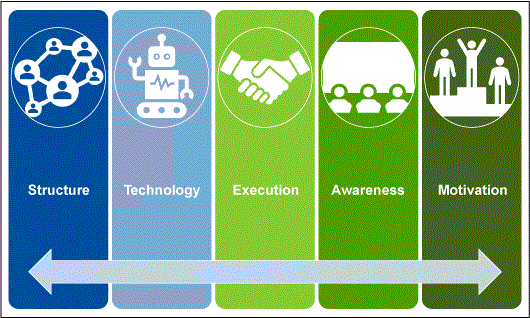
The model in Figure 1 below shows what should be the prominent pillars of ideation for firms embarking on this journey or trying to reorganize their innovation department. Each attribute under this model has a few important activities that can ensure a successful innovation pipeline for your business.
Six Sigma Study Materials, Six Sigma Guides, Six Sigma Learning, Six Sigma Tutorial and Material, Six Sigma Online Exam
The STEAM Model

1. Structure

Innovation should be infused in the operating culture of a company and defined in a well-structured manner. How do you accomplish this?

1. Identify a subject-matter expert (SME) in each department (like operations, quality or training) as well as shared services like HR, finance and others.

2. Educate staff members about the ideation SMEs with whom they can share their ideas.

3. Each SME should be responsible for driving ideation through idea generation, brainstorming sessions and workshops.

4. The SMEs should do a first-level validation check of the ideas and share their feedback with the idea creators.

All feasible and relevant ideas can flow to an ideation committee comprising senior leaders, SMEs and members from supporting functions such as IT and automation.

2. Technology

Each firm has its own technological suite of solutions; the first step in leveraging these tools is understanding and mapping their capabilities and opportunities. An idea has diverse meaning across clients. For some, innovation is deploying high-end robotic process automation (RPA) or artifical intelligence capability to automate some parts or most of a job, while for others it would mean providing suggestions to improve the overall process flow by eradicating effort leakages. There is no point in pitching a RPA solution to the latter situation and vice versa. So, how do you take advantage of tech capabilities?

1. Understand what the customer’s needs are from a technological standpoint.

2. Build an ideation platform wherein employees can submit their ideas. Start with an Excel spreadsheet if you need to, but begin collecting ideas.

3. Educate staff members about all of the company’s offerings and let them assess if the offerings help the end customers, clients and employees.

4. Connect the ideas received from front-line staff to your solutions.

3. Execution

When you’ve picked the ideas that are both relevant and able to be implemented, convert them into projects. There is only one rule at this stage – execute and advertise (internally). How you market the success of your first few projects will determine the way employees will perceive the ideation initiative. Be sure that the company recognizes the idea submitter – make them a hero and you will see the urge to find opportunities in everyday work become a new water cooler topic among the rest of the staff. The following pointers will lead you to a more robust outcome.

1. Categorize ideas properly before execution.

2. Follow up and follow through. Once the project has been initiated, bring it to its logical conclusion.

3. Analyze benefits – manhours, customer satisfaction, employee satisfaction, voice of the customer and any other metrics that you measure.

4. Advertise internally.

5. Iterate and cross-replicate wherever possible – across departments, verticals, projects, etc.

4. Awareness

During the initial stage, expect more greviances than actual ideas. Instead of neglecting these, educate the idea submitters. Show them examples of the ideas you’re looking for, give them relevant problem statements and ensure proper feedback is provided.

1. Educate about the ideation framework and structure.

2. Run contests, workshops and town halls.

3. Walk the talk – make this a talking point in your reviews and meetings.

4. Use visual content such as posters, videos and mailers to communicate.

5. Involve everyone from the senior leadership to front-line staff members.

5. Motivation

An employee-centric rewards and recognition program is crucial to disperse the culture of innovation. Show appreciation to the individual who submitted the idea, the team members of the project and the SMEs. Don’t reserve this for only the great ideas – appreciate every idea. Thank everyone for their contribution. Nobody has ever been hurt from extra appreciation.

1. Reward top ideas across categories and departments.
2. Identify, nurture, coach and appreciate the best innovation SMEs across departments.
3. Thank everyone who contributes.

Phases of the Ideation Framework


This model may seem simple to implement but once you get started you will find this is much harder than it looks. You will not find immediate success. There will be a large group of employees who will not see the value in ideation. This change, therefore, needs to be managed carefully in the phases shown in the table below.

Phases of the Ideation Process
Stage Number Stage  Focus On  Expected Outcome  Pace 
1 Cultural shift Awareness and culture Quantity of ideas Slow
Implement  Execution of good ideas  Quality of ideas  Fast 
Feedback  Celebrating success stories  Motivation  Moderate 
You will start seeing results once:

◉ You’ve established a strong ideation framework wherein an idea flows smoothly from one stage to another.

◉ The submitter receives frequent updates, is involved in the innovation process and recognized for their efforts.

Ideation is not only about generating ideas but also how well you execute, nurture, educate and replicate. It’s not a destination – it’s a journey.

Saturday, 9 November 2019

PRINCE2 Foundation for Beginners: From Introduction to Passing Your PRINCE2 Foundation Certification Exam

PRINCE2 Foundation is the required level of certification. The staff member/employee working for the Organization can give their best techniques to the company, which further increases their revenue and profits.
prince2 foundation exam questions, prince2 foundation practice exam, prince2 foundation mock exam, prince2 foundation questions and answers pdf, prince2 foundation sample exam, prince2 foundation exam questions and answers, prince2 foundation questions, prince2 foundation exam questions and answers pdf, prince2 foundation exam sample

The PRINCE2 Foundation exam is intended to establish that you will be able to act as an educated and trained member of a project management team using a PRINCE2 environment that is recommended. To pass, you will require to show that you know and remember the principles and the terminology of the method.

Therefore, you need to prove that you have understood the purpose and the original content of the roles, the eight elements, the eight processes, and the sub-processes of them as well as the techniques.

You must also understand which management product is input to, and output from, and the eight processes, the primary purpose of the essential contents of these fundamental administration products. You should also be able to manage the relationships between the means, the deliverables, roles, and the management dimensions of the project.

Tips to Prepare for PRINCE2 Foundation Certification

It is not that easy to pass the PRINCE2 Foundation exam in the first attempt. Here are a few tips which will make your exam day simpler.

It is Not Just a UK Thing:

  • PRINCE2 was initially developed by the government of the United Kingdom to manage large-scale public sector projects. However, today, it’s used in countries all around the world for public and private sector projects.

Set up Your Schedule:

  • Every project requires a good schedule, and this examination certainly does not deviate from that rule. Exam day will be here before you even understand it, and therefore, prior planning cannot be abused. You require to set up and ensure that you adhere to your course work, revisions, and exam schedule as well as deadlines, and you should also have built-in risk factors.
  • As you can see, this is like how you would execute an actual project. If you are not good at organization, you will have to sustain and hone that capacity in you if you want to work happily in project management.

Go Through the Answers:

  • The answers are as relevant as the questions. As the exam is of multiple types, you will have to choose answers from various options provided in the questions. Primarily, observe the sort of language used in the answers. Always avoid selecting answers that say ‘all,’ ‘always’ or ‘must.’

Practice PRINCE2 Foundation Sample Questions:

  • Practice makes perfect! Keep practicing the sample question papers while timing yourself. This will aid you in becoming used to the question format and working at a speed needed in the examination.
  • If you get doubts while practicing, then you can discuss it with your trainers.
  • Since the sizes of the classes are usually kept small, each student gets an equal scope on getting their reservations clarified both with their trainers and classmates. It also results in building harmony amongst the students and trainers.

Mind Maps:

  • Get used to the study material to learn the subject. When you believe about the different factors, you begin connecting them reasonably. This can be done by bringing mind-maps. You can build one for every theme and process.
  • Mind-maps are performed in the pre-course material, but you should make your own too. It will assist you in the long term and assist you in relating yours with the ones offered in the pre-course material.

Answer as Many You Can:

  • There is no denying marking in this examination. Just in case, during the PRINCE2 Foundation examination, you come short of time but still want to answer all the questions, you even can guess the answers on the outstanding questions and mark them on the answer sheet. Who understands, some of your marked answers might become correct and might make a variety between failing and passing the examination.

Ensure You Clearly Understand the Different Perspectives:

  • During the exam prep, assure that you know the different roles and responsibilities and also all the duties of a distinct position in the project management team. Knowing the sequence of all processes is also crucial. This includes figuring out who is accountable for a specific activity in a project. There are many themes covered in the PRINCE2 manual.
  • For the PRINCE2 Foundation Exam, you require to be thorough with all the purpose statements introduced at the beginning of each process or theme. How a principle is used in a particular method should also be identified to you. Other essential features of the Practitioner exam are product planning.
  • You want to have a thorough idea of the diagrams and product descriptions under product planning. Though you do not need to draw diagrams in a multiple-choice question, it will be simpler to solve the problems if you can efficiently draw the diagrams.

Do Not Panic in the PRINCE2 Foundation Exam:

  • The exam begins, and you hit the ground running.
  • Steady! First, read through everything cover to cover. Then read each question, underline keywords, and ultimately answer the question asked.
  • Do the simple questions beginning and review your answers at the end. Watch the clock, and time can ebb away very quickly.
  • And if you fail, don’t worry. You can always re-take, remember to keep calm and carry on!

Get Plenty of Rest the Day Before:

  • Do not walk into your exam like a zombie. Wake up fresh on the D-day with lots of rest behind you. If you can see all 8 hours of sleep.

Eat Before Work:

  • Do not ever go to the exam on a vacant stomach. The last point you want is a gassy, rumbling stomach that is misleading or just dull apathy because well, your body is running on fumes.

Things that will be provided in the PRINCE2 Foundation Examination:

Scenario Booklet

  • You will get a booklet that will have a hypothetical project scenario for you, generally presented as an A4 text sheet. The questions of the examination are based on this real scenario.

Question Booklet

  • This booklet comprises 60 questions, with each subject being labeled as ‘PRINCIPLES, ORGANISATION, DIRECTING A PROJECT,’ and many more.
  • The questions will be in the same order as the topics in the manual.

Answer Sheet

  • The answers require to be filled in the grids provided that clearly show which question the network refers to. You will be presented with a pencil and an eraser.

Conclusion

Formal certification is always wanted from a career point of view as it helps you to gain better job opportunities and enhance your pay grade. It is also evidence that you have fully understood all the concepts of project management. Being skilled in a particular project management methodology is a vital addition to your skillset.

How you are going to fare in the Foundation examination is driven only by the method you plan to study to get PRINCE2 Foundation Certified.

But the tips and tricks that we finished explaining in detail will help you in clearing the Foundation exam.

We wish you all the best for your preparations!

Friday, 8 November 2019

How do I Start My Project Manager Career?

Maybe someone you know works in Project Management and you have done a bit of research. You have gone onto job boards, noticed there are many job adverts for junior and experienced project managers. You have looked at average salaries and discovered that project management is a professional career that pays well. So, you would like to seriously explore project management as a career option for yourself.

Project Manager Career, PMP Study Material, PMP Guides, Prince2 Study Materials

You have evaluated your current situation, thought about setting a 2-year goal and maybe a 5-year career goal for yourself. By investing in yourself a bit by learning the skills you would need and adding some certifications to your CV to catch the eye of recruiting managers out there, you have the beginning of a plan to get a career started.

As you have never worked as a member of a project team or as a project manager, you must ask yourself the following questions first to ensure that project management is the right career choice for you before you commit to a study investment:

1. What traits must I have to succeed?
2. Am I committed enough to invest in myself?
3. How do I get started?

What traits must I have to succeed?


If you love technology and fixing PCs and laptops, then it makes sense for you to have a career in IT. Choose a career that you are suited for and will love, so make sure project management is right for your traits. Fortunately, project management cuts across all career sectors which makes it easier to be involved in projects that follow your natural interests.

You spend 45 years on average working, so it makes sense to forge a career in what you are good at and enjoy!

Project Management requires managing, coordinating, communicating, following processes, analyzing, recording information, dealing with challenges, managing change, working with different people, following a methodology all while focusing on delivering a successful project that is completed on time and within budget.

So, let’s explore what traits are useful for project staff:

1. Good at planning

2. Naturally structured

3. Ability to follow processes

4. Coordination skills

5. Very good written and verbal communication

6. Good team player

7. Able to deal with change

8. Analytical

9. Good at building rapport

10. An eye for detail

11. Ability to learn and understand a methodology (like PRINCE2 or AgilePM)

Some projects need other traits like creativity and innovative thinking especially in the creative space or when working on projects creating new products or services.

Successful Project Managers are not born with all the skills listed above. Some of these traits can be learned and some will come naturally to you. Some will be your strength and other areas you need to work on and develop.

Am I committed enough to invest in myself?


So, let’s assume you have a good mix of project manager traits and you are still keen to find out more about getting started with your project manager career. Next you need to test your commitment, are you committed enough to invest in yourself?

To make it easy to start your project manager career you need to invest in yourself. You will want to stand out in the job market by making sure you have recognized project manager certifications on your CV. Please ensure you choose certifications like PRINCE2 or AgilePM to study which are accredited in the UK and not the USA.

If you are planning to work in the USA or work specifically for US companies then google PMI and find out more.

For the purpose of this blog, I am focusing on a career in the UK, Europe and countries like Australia, South Africa and New Zealand that predominately use PRINCE2 and AgilePM as their chosen methodologies for managing projects.

Studying and gaining the certifications needed to work in project management will be a money investment and a time commitment. With experienced project managers earning £52K+ annually in the UK, it makes it easier to find the commitment and drive to succeed.

If you are flipping burgers at a fast food chain earning £15,000 per year, but have the ambition to triple your salary, you must become career focused. A career happens when you invest in yourself. Investing in yourself can cover learning new in demand skills, refreshing out of date skills and working on areas of weakness. A great way to start your journey to career success in project management is to have a study plan and plan your career. ‘Failing to plan is planning to fail’.

Are you committed enough to take a blank piece of paper and write down a 2-year career goal for yourself? Your goal needs to be a S.M.A.R.T goal, your goal needs to be:

◉ Specific
◉ Measurable
◉ Achievable
◉ Relevant
◉ Time-bound

Write down what you would like to achieve in 2 years, then write down what you need to do to achieve your goal. Its easy to say I want to become an astronaut, but if you do not have a plan, the skills needed, the opportunity, the drive, the commitment, then you will never achieve your goal. The same goes for Project Management.

Once you have a 2-year goal written down with your plan of how you are going to achieve your goal, then you just need a bit of drive and commitment and you can get there.

It is also a good idea to do the same with a 5-year goal plan.

Once you have nailed your goals down, then imagine how you will feel once you have achieved your goals! Think about that for a second!

Read More: Project Management

Wednesday, 6 November 2019

The Fastest Way to Achieve Zero Defects

In the aerospace industry, zero defects has been the driver for customers and competition since Phil Crosby and his team at the Martin Company provided the Army with a zero defect missile in the 1960s. This is not a new concept but the first question that comes to mind is: how much do we need to invest before we achieve zero defects? Once we embrace the fact that zero defects is not a final destination but a journey, it becomes easier to start asking the right question: how do we get started?

This article will attempt to provide a low-cost way of deploying zero defects with little or no investment. First, a review of a generic zero-defect deployment roadmap for years one, two and beyond that is based on my experiences from three different industries – chemical, medical and aerospace. Then we will look at the most recent deployment of zero defects from my present place of employment. Finally, I will reflect on some guiding principles that are keys to the speed and sustainment of the zero-defect culture.

Generic Deployment Roadmap and the Elbit Systems Journey


The goal is to arrive at a state where it is part of the culture to continuously address and prevent small problems from becoming projects – or worse, defects. The roadmaps below present a generic roadmap for years one, two and beyond (Figures 1, 2 and 3). The last section shows what a stable state looks like at a high level. The example of Elbit’s journey follows the generic roadmaps.

Six Sigma Tutorial and Material, Six Sigma Guides, Six Sigma Certification, Six Sigma Study Materials

Figure 1: Year 1 of starting a zero defect or any continuous improvement program. The new addition indicates a key success factor that is commonly missed during preparation.

Year 1 needs to focus on two things:

1. A pilot that will exhibit the potential of using the tools
2. Setup for a long continuous improvement journey

Selecting the pilot is typically not difficult if you are working with management. The latter requires a great deal of information gathering, training at a high level and putting mechanisms in place that will serve as drivers for continuous improvement.

Six Sigma Tutorial and Material, Six Sigma Guides, Six Sigma Certification, Six Sigma Study Materials

Figure 2: Year 2 of starting a zero defect or any continuous improvement program. This is the year of standards, maximizing communication and coordination between functions and teams.

Year 2 needs to focus on building speed of continuous improvement – training and structure. The trainers need to expect to be teaching, coaching and following up continuously.

Six Sigma Tutorial and Material, Six Sigma Guides, Six Sigma Certification, Six Sigma Study Materials

Figure 3: Year 3 and beyond of any continuous improvement program. This is the year where we start sharing best practices, sustaining the speed of improvement by building it into procedures, how we plan budgets and continuously train the organization.

Year 3 is the first year where the continuous improvement journey should follow a standard recurring set of activities.

Example from the Journey at Elbit Systems (Supplier of Vision Systems to Aerospace)


The zero defects journey at Elbit Systems follows the policy of “don’t ship a defect” to the customer, “don’t make a defect” during assembly and “don’t buy a defect” from the supplier (Figure 4).

Six Sigma Tutorial and Material, Six Sigma Guides, Six Sigma Certification, Six Sigma Study Materials

Figure 4: Journey of Elbit Systems from plug and pray (i.e., low yields at test) to plug and play (100 percent first-pass yields). We sustained a zero-defect state at final test in March 2017. We reduced 30 percent of defects at assembly by June 2018. The challenge now is “don’t buy a defect,” which entails getting our suppliers to embrace a zero-defect journey.

Zero defects during year one was all about getting the final test yield to 100 percent. The second year was about putting process controls (Figure 5) in place, educating the suppliers and performing failure mode and effects analysis (FMEA). After that, during weekly zero defect reviews with management, we used FMEA to show the top risks and activities to reduce the defects.

Six Sigma Tutorial and Material, Six Sigma Guides, Six Sigma Certification, Six Sigma Study Materials

Figure 5: Process control deployment is critical to standardizing and sustaining gains in zero defects.

The important thing to note with the use of the FMEA is that we not only addressed ongoing defects but also ensured that potential risks are not realized during production.

Guiding Elements


Here are some elements that are critical to both speed and quality of deployment:

1. How can we achieve zero defects faster than anyone else? By learning faster than anyone else. I recommend using just-in-time training and a structured approach. It may be better to train only when there is assurance of immediate implementation such as just before a Kaizen or a scheduled activity. Structure of DMAIC (Define, Measure, Analyze, Improve, Control) or PDCA (plan, do, check, act) can be easily driven by requiring A3s. Note: Be aggressive about use of visuals and data in A3s; remind everyone that A3s are stories not mere record-keeping.

2. How can we drive zero defects through the organization and external parties? The application of tools. Asking, “which tools did you use,” should start and end every discussion.

3. Remember Lean is about creating wealth by eliminating waste and creating value in its place. Six Sigma is about making a change based on data (not based on opinions or tweaking). Data is the lifeblood of any continuous improvement program.

4. Figure 5 shows how different tools work together to control process performance. Note: Just by making team members aware of how the process is behaving with numbers can change their behaviors and drive them to make the right decisions. Eighty percent of the benefits from implementing process controls comes from simply charting failures immediately after they happen.

5. Figure 6 is the most useful representation of the change curve and extremely useful when preparing for a Kaizen event or managing a process improvement project.


Six Sigma Tutorial and Material, Six Sigma Guides, Six Sigma Certification, Six Sigma Study Materials

Figure 6: The Kubler Ross Change Curve and how to handle every change situation.

Tuesday, 5 November 2019

Design for Six Sigma - IDOV Methodology

Design for Six Sigma (DFSS) can be accomplished using any one of many methodologies. IDOV is one popular methodology for designing products and services to meet six sigma standards.

Six Sigma Study Materials, Six Sigma Learning, Six Sigma Guides, Six Sigma Certification, Six Sigma Online Exam

IDOV is a four-phase process that consists of Identify, Design, Optimize and Verify. These four phases parallel the four phases of the traditional Six Sigma improvement methodology, MAIC – Measure, Analyze, Improve and Control. The similarities can be seen below.

Identify Phase


The Identify phase begins the process with a formal tie of design to voice of the customer (VOC). This phase involves developing a team and team charter, gathering VOC, performing competitive analysis, and developing CTQs.

Crucial Steps:

◉ Identify customer and product requirements

◉ Establish the business case

◉ Identify technical requirements (CTQ variables and specification limits)

◉ Roles and responsibilities

◉ Milestones

Key Tools:

◉ QFD (Quality Function Deployment)

◉ FMEA (Failure Means and Effects Analysis)

◉ SIPOC (supplier, input, product, output, customer product map)

◉ IPDS (Integrated Product Delivery System)

◉ Target costing

◉ Benchmarking


Design Phase


The Design phase emphasizes CTQs and consists of identifying functional requirements, developing alternative concepts, evaluating alternatives and selecting a best-fit concept, deploying CTQs and predicting sigma capability.

Crucial Steps:

◉ Formulate concept design

◉ Identify potential risks using FMEA

◉ For each technical requirement, identify design parameters (CTQs) using engineering analysis such as simulation

◉ Raw materials and procurement plan

◉ Manufacturing plan

◉ Use DOE (design of experiments) and other analysis tools to determine CTQs and their influence on the technical requirements (transfer functions)

Key Tools:

◉ Smart simple design

◉ Risk assessment

◉ FMEA

◉ Engineering analysis

◉ Materials selection software

◉ Simulation

◉ DOE (design of experiments)

◉ Systems engineering

◉ Analysis tools

Optimize Phase


The Optimize phase requires use of process capability information and a statistical approach to tolerancing. Developing detailed design elements, predicting performance, and optimizing design, take place within this phase.

Crucial Steps:

◉ Assess process capabilities to achieve critical design parameters and meet CTQ limits

◉ Optimize design to minimize sensitivity of CTQs to process parameters

◉ Design for robust performance and reliability

◉ Error proofing

◉ Establish statistical tolerancing

◉ Optimize sigma and cost

◉ Commission and startup

Key Tools:

◉ Manufacturing database and flowback tools

◉ Design for manufacturability

◉ Process capability models

◉ Robust design

◉ Monte Carlo methods

◉ Tolerancing

◉ Six Sigma tools

Validate Phase


The Validate phase consists of testing and validating the design. As increased testing using formal tools occurs, feedback of requirements should be shared with manufacturing and sourcing, and future manufacturing and design improvements should be noted.

Crucial Steps:

◉ Prototype test and validation

◉ Assess performance, failure modes, reliability and risks

◉ Design iteration

◉ Final phase review

Key Tools:

◉ Accelerated testing

◉ Reliability engineering

◉ FMEA

◉ Disciplined new product introduction (NPI)

Monday, 4 November 2019

Increase Lean Six Sigma's Power with TOC and Systems Thinking

Lean Six Sigma (LSS) has demonstrated the ability to produce outstanding results; over time, however, returns from LSS may begin to slow. One of the more common reasons cited for slowing returns is poorly targeted projects. This occurs because organizations fail to recognize that continuous improvement efforts need to be addressed on a systemic level rather than within a department or function in isolation. Although improvement projects carried out in isolation can yield short-term results, they also can translate into having minimal, or even a negative, impact on overall organizational performance.

In order to achieve maximum and consistent returns with LSS, efforts must be focused on improving overall system performance. Seeing and understanding the whole system can be accomplished by combining Lean Six Sigma with systems thinking and the theory of constraints (TOC). This article demonstrates the necessity and benefits of combining these methodologies into a single continuous improvement approach.

Systems Thinking: The Opposite Approach to Lean Six Sigma


Continuous improvement programs that use LSS generate improvements by disassembling the process into smaller pieces. This is known as an analytical approach. However, often an analytical approach will fail to provide an adequate understanding of the problem due to the dynamic complexity of the situation (see table, “Difference in Approaches to Problem Solving” and sidebar, “The Difference Between LSS and Systems Thinking – An Example”). It is within this realm that the tools of systems thinking become a valuable asset to a continuous improvement program.

Difference in Approaches to Problem Solving
Systems Thinking  Synthesis: understanding the whole by looking at the relationships among its parts. 
Lean Six Sigma  Analytical: understanding the whole by taking it apart and looking at the pieces. 

The Difference Between LSS and Systems Thinking – An Example


An aircraft can be viewed as a system that has the purpose to fly. With an analytical approach (Lean Six Sigma) to understanding the system, the aircraft (wings, avionics, etc.) is disassembled with the pieces spread out on the hangar floor. After each individual part is analyzed, the function of each of part is understood. But, still, how does the aircraft fly?

That is unknown, because in isolation the parts do not create a system capable of flight. To understand flight, a synthesis approach (systems thinking) must be used to understand how the parts work together to create the necessary conditions to achieve flight.

In this example, an analytical approach helps gain an understanding of what the parts do and how they work. Systems thinking, on the other hand, explains why flight is possible.

The term system is defined as a whole that consists of parts, each of which can affect the others behaviors or properties.1 In other words, performance of the system is determined by how parts interrelate. In business, the manner in which sales, procurement, manufacturing and distribution relate to each other is what drives business performance, not the isolated performance of each department.

An example of how the approaches differ can be found when an organization attempts to improve the efficiency of distribution and warehousing. In an analytical approach, improvements are made based solely on the processes within that department. In reality, the root causes of inefficiencies within that department can originate from any combination of procurement planning, production scheduling and capabilities, sales forecasting, people, the market conditions, and more. Despite the interrelationship between warehousing and other departments throughout the organization, continuous improvement programs launch projects and Kaizen events aimed at making localized improvements in the warehouse. This is not an uncommon occurrence in LSS deployments and can negatively impact a deployment’s ability to maintain momentum and generate returns.

To see the “whole,” systems thinking creates diagrams using reinforcing or balancing feedback loops, system delays and archetypes. A system archetype is a pattern of behavior within a given system, and in the example represents an organizational problem to be addressed.

The example shown in Figure 1 is based on work at a large public energy company that was deploying LSS as well as applying systems thinking. The company created a systems diagram of the customer service department because of an increasing number of customer complaints. The diagram revealed that the decisions made by the department when customer complaints were received was the leverage point in the system. (In systems thinking, a leverage point is where within the system a solution can be applied.)

Six Sigma Tutorial and Material, Six Sigma Guides, Six Sigma Learning, Six Sigma Study Material

Figure 1: Systems Diagram from a Public Utility

The company concluded that over time actions taken by the customer service department in response to customer complaints had led to higher costs and more complaints. That conclusion was surprising to company leaders because the department’s key indicators rated customer service among the best-performing departments in the organization. They had expected the cause of increasing customer complaints to stem from issues related to the administration of energy service. The exercise of creating a systems diagram served as a powerful collaborative learning experience that aligned the organization around the need to deploy LSS resources to examine the policies, metrics and processes within the customer service department. Something was clearly amiss if the metrics used to monitor the customer service department suggested excellent performance, yet customer complaints and company costs were rising.

Although this example does not dismiss the need to address problems with equipment reliability or reducing network failures, it does emphasize the need to address the underlying systemic root causes of higher costs and complaints.

Another example of the benefits of combining systems thinking and continuous improvement comes from Dantar Oosterwal, former head of the new product development department at Harley Davidson Motor Company. Oosterwal and his team leveraged systems thinking and Lean to challenge the traditional phase-gate approach to product development. The result was a knowledge-based product development approach that accelerated the average number of new models released to the market per year from 0.74 in 1996 to 4.6 models in 2007 – a dramatic performance increase. At the end of his book, Oosterwal emphasized the necessity of systems thinking in continuous improvement programs by stating that “with a focus on tools and techniques there may be a monetary improvement, but the change they usher in will not become embedded as part of the system; the change will just become another fine program.” If LSS becomes just another program, then leadership will quickly find ways to better use the resources and a great program will eventually die.

Theory of Constraints: A Structured Approach


The challenge of combining systems thinking with LSS stems from the perception that systems thinking is often too nebulous or academic to implement. TOC provides a structured approach to identifying leverage points, referred to as constraints in TOC language. The TOC is based on the idea that the overall performance of an organization, or system, can be improved by focusing on the increase in throughput at the constraints of the system. Simply stated, a system constraint inhibits throughput of products or services through the organization, therefore reducing the ability to make money, both now and in the future.

According to TOC, constraints typically take three forms: physical, market or policy. Viewing the public utility example through the lens of TOC, the system constraint is the policies within the customer service department. These policies created the metrics, the processes and the culture. The culture drove behaviors that led to actions, which eventually resulted in increased costs and more complaints. TOC encourages the same principles outlined in systems thinking by considering the whole, as well as cause and effect. The TOC uses an intuitive five-step methodology to provide a continuous improvement program for the organization.

Six Sigma Tutorial and Material, Six Sigma Guides, Six Sigma Learning, Six Sigma Study Material

Figure 2: Five-step Theory of Constraints

As Figure 2 illustrates, TOC provides an effective, step-by-step continuous improvement approach that 1) gives simple and clear guidance on where to improve, 2) communicates how to manage the organization to achieve maximum throughput, and 3) gives guidance on what to do before making additional investments (such as a new technology). When TOC is combined with LSS, the organization significantly increases the effectiveness of targeting projects because resources will be targeted on the system constraints. One study found that combining TOC, Lean and Six Sigma in a logical sequence yielded up to four times better (financial) results than using Lean or Six Sigma alone.

An excellent example of combining Lean and TOC comes from the U.S. Marine Corps Logistics Center in Albany, Georgia. The MK-48 maintenance team had challenges with capacity and returning repaired vehicles on time to their customers. The team identified a policy that was constraining the throughput of the maintenance process (TOC), then implemented a pull-system (Lean) to schedule maintenance activities. These activities resulted in on-time performance of 99 percent of the production lines.

Advantages of Looking at the Whole System


To avoid the loss of momentum or slowing results that can come over time, continuous improvement programs must enable the organization to see the whole system while discouraging efforts that are aimed at localized improvements. The examples cited in this article demonstrate the advantages of combining LSS, systems thinking and TOC into a single continuous improvement program, including:

◒ Significant improvement in targeting of LSS projects

◒ Improved alignment with leadership goals because continuous improvement efforts will be focused on system performance rather than local optimization

◒ Intuitive five-step approach of TOC to helps organizations determine where to focus, what to improve and when to consider future investments

◒ Compatibility and complementary nature of LSS, systems thinking and TOC

◒ Potential for up to four times better (financial) results than using Lean or Six Sigma alone

Although the best way to integrate these approaches is beyond the scope of this article, it is safe to say that any integration should include open-mindedness within the LSS program. True continuous improvements professionals understand that in order to continuously improve one must continuously learn.

Saturday, 2 November 2019

Creating a DMAIC Pathway for Innovation

On the surface, the DMAIC roadmap and the concept of innovation appear to be mutually exclusive ideas. At least that’s what many critics have claimed is the Achilles’ heel of the Six Sigma methodology. Six Sigma and innovation, after all, tend to personify a natural tension that exists within quality-enhancing activities at any organization – a tension between exploitation and exploration.

Six Sigma Study Materials, Six Sigma Learning, Six Sigma Guides, Six Sigma Tutorial and Material

The general wisdom holds that Six Sigma is an “exploitation” activity, while innovation is usually associated with “exploration.” When I speak of exploitation, the term is not being used to describe the act of gaining advantage through unfair means. Instead, it is to transform an organization’s inputs into profitable outputs under its existing business model. As for exploration, the term here refers to the organization’s efforts to pursue new potential business models, novel product or service areas, or both. In short, the former is concerned with current practices, while the latter focuses on discovering new ideas.

However, innovation and Six Sigma do not need to be combatants. In fact, they can act as compatriots; and in some cases Six Sigma can actually be seen as an innovative approach. To get a better understanding of innovation and it complex, ambiguous relationship with Six Sigma, it helps to dig deeper into the definition of innovation. As I see it, innovation transforms the useful seeds of invention into widely adopted solutions that are valued above every existing alternative.

Shared Goals, Different Outcomes


Both Six Sigma and innovation have a distinguished history. The concept of innovation dates back nearly 500 years, as a derivation of the Latin term innovare, which is interpreted as “to renew or change.” In the modern era, the most-often-referenced godfather of innovation is Joseph Schumpeter, a 1930s-era economist. Meanwhile, Six Sigma has been used by organizations for more than 25 years after getting its start at Motorola and being popularized by GE and other corporations.

Regardless of the differences in approach of these methods, most people can agree that both Six Sigma and innovation are focused on improvement. However, while Six Sigma is based on decreasing variability, innovation focuses on increasing value. Sometimes an increase in quality through a decrease in variability does create increased value for the customers; sometimes it doesn’t.

How could increased quality through and decreased variability not lead to an increase in value? The key lies in the “widely adopted” terminology of my innovation definition. New solutions may provide an increase in value that is obvious to the inventor, but not to the customer. The customer may even perceive the new product or service as a decrease in value, which, in turn, will prevent the solution from being widely adopted. This is what can keep a mere invention from graduating into a true innovation.

This discrepancy in perception between the inventor and the customer is why things like the incandescent light bulb and the traditional mousetrap stay around for so long, despite the introduction of other potential solutions.

Natural Conflict


While Six Sigma and innovation are not mortal enemies, there are some key differences between them that create natural conflicts. These differences require managers to remain vigilant about how they should merge the use of these two approaches (if at all) in their organizations.

Six Sigma Study Materials, Six Sigma Learning, Six Sigma Guides, Six Sigma Tutorial and Material

The main tension between the two approaches is that Six Sigma requires accurate measurement. How else but through measurement will you know whether a Six Sigma project has resulted in decreased variability and a sustainable improvement? On the flip side, the more radical or disruptive an innovation project is, the more difficult it will be to measure accurately the expected risk of the project and the projected profitability and adoption possibilities.

A great example of the difficulties of forecasting risk and outcomes is the Segway transportation device. Imagine you were in charge of the project back in 2000. How would you size the market? How would you forecast the media response? How would you estimate the risks to the project posed by sidewalk regulations? How would you measure consumer readiness?

Most forecasts for new products or services are based on old forecasts, a naturally flawed measurement approach. However, forecasting simply loses all credibility when it is applied to disruptive innovations. This inherent uncertainty is why successful innovation is often the result of asking the right questions, while success with Six Sigma is often the result of finding the right measurements.

The mindset created by the need for accurate measurement is congruent with typical executive thinking, which brings me to another common tension in business – that between the executive and the entrepreneur. Mismanagement of this tension is one of the greatest obstacles that prevent organizations from innovating sustainably.

Let’s compare these two mindsets:

◈ The Executive Mindset – Executives typically are focused on what they can do to avoid failure. They tend to focus on doing everything they can to make the trains run on time, so to speak.

◈ The Entrepreneurial Mindset – Entrepreneurs typically are focused on trying to do whatever they can to create success. When faced with train delays, entrepreneurs tend to ask, “Why take a train?”

These natural tensions mean that managers have to be careful when implementing Six Sigma in some of the more creative aspects of the business. Otherwise, there is a real possibility of stifling the unstructured thinking in areas such as design and research and development (R&D), where partial ideas need to be collected and connected to form strong innovation candidates.

DMAIC for Innovation


Although managers must take care in implementing Six Sigma in the more creative aspects of the business, there is a way to implement the DMAIC roadmap within these functions. I have stretched its usage a bit further and created a DMAIC roadmap for innovation.

Define

Imagine that you work for an automobile manufacturer and you are asked to solve the following technical challenge: “How would you make our automobiles use less gasoline?”

Think about what your approach would be. Some might focus on making the automobile lighter; others might focus on making the engine more efficient. Still others would focus on making the car more aerodynamic, and a few would think about ways to make it ran on something other than gasoline. The results you get will depend on the innovation questions you ask.

Any successful innovation effort begins with a cross-functional innovation leadership team defining what innovation means for the organization, establishing a common language and clearly communicating this message to the organization. While it is sometimes good to have people going off in many different directions at once, that needs to be a conscious choice; otherwise, the innovation energy of the organization will dissipate and little will be achieved. Defining a common language around innovation will help focus this energy.

Articulating an innovation vision also will help provide this focus. A vision is about the “where” and the “why,” not the “what” or the “how.” Jack Welch, former CEO of GE, once said, “Good business leaders create a vision, articulate the vision, passionately own the vision and relentlessly drive it to completion.” An innovation vision can help employees answer questions like, “What kind of innovation are we pursuing as an organization?” or “Why should employees, suppliers, partners and customers be excited to participate?”

Organizations also must define their innovation strategy. This is not merely an agenda for new product development or a technology roadmap from R&D. Instead, an innovation strategy identifies who will drive a company’s profitable revenue growth and sets the innovation direction for an organization toward the achievement of its vision. A well-defined innovation strategy helps the organization define which innovation challenges to focus on and what tactics will best help the organization conquer those challenges. At the same time, it serves as a map to refer back to as projects and ideas are being evaluated, so that, ideally a link can be maintained between the organizational and innovation strategies.

Measure

While it is often harder to estimate the market size for true innovations than it is for line extensions or product improvement projects, it is still important to measure certain things related to innovation. Here are some key innovation measurement questions that need to be asked:

◈ What are the organization’s innovation goals?
◈ What is the capacity for innovation in the organization?
◈ What is the organization’s appetite for risk?
◈ How will the organization finance innovation projects?
◈ How will the organization measure the innovation’s success?

Analyze

Innovation requires a great deal of analysis. This includes analysis of the key insights from which the team generates ideas; analysis of the brand equity and capabilities of the organization that can be leveraged; analysis of what direct and adjacent competitors are doing now; and analysis of the future strategic actions that competitors are expected to take. In completing this analysis, it is useful to use a methodology like Rowan Gibson and Peter Skarzynski’s four lenses from Innovation to the Core (Harvard Business Press, 2008):

◈ Challenging orthodoxies: Questioning deeply held dogmas inside companies and inside industries about what drives success.

◈ Harnessing discontinuities: Spotting unnoticed patterns or trends that could substantially change the rules of the game.

◈ Leveraging competencies and strategic assets: Thinking of a company as a portfolio of skills and assets rather than as a provider of products or services for specific markets.

◈ Understanding unarticulated needs: Learning to live inside the customer’s skin, empathizing with unarticulated feelings and identifying unmet needs.

The Analyze phase is not simply about generating insights; it also is about generating the ideas. When it comes to innovation, people don’t always realize that their “great ideas” are actually only partial ideas. So, another part of the Analyze phase, when it comes to innovation, is the connection of partial ideas to create potentially complete solutions. During Analyze, there also is a great opportunity to take these raw ideas and make them better. The crescendo of this phase is the analysis of all of the potential ideas, their evaluation by cross-functional teams and the final picking which ideas to fund.

Improve

The Improve phase is about getting down to business, developing the selected ideas and creating the actual innovation. This includes prototyping, market testing, customer feedback and – most importantly – learning and iterating. A key part of this iteration is finding the right questions (and answers) to highlight reasons for potential market success or failure.

But there is another part of innovation that is often under-appreciated: the role of communication. When bringing an innovation to market, an organization also is bringing new value to customers that they may not understand intuitively.

Too often, companies fail at innovation because they ignore the importance of communication. How can you contribute to the improvement of an idea if you don’t understand what it is or the magnitude of its impact? Internal communication can help turn employees into passionate believers and supporters of the ideas. Externally, communication can help explain the new value for an incremental innovation, or to educate the customer about the value of a disruptive innovation.

Control

Control is about making innovation repeatable, sustainable and successful in the organization. How do you make innovation a deeply embedded capability of the organization? The organization must move from pursuing a “firefighting” approach to innovation and instead create a continuous process with organizational commitment at every level.

Organizations can work to build a company culture with improved tolerance for risk and an understanding that failure is a real possibility. Instead of avoiding failure, innovative companies seek success and mitigate failure through a portfolio approach (working on a collection of strategically similar projects at once) and by embedding an ability to learn fast from failure or success.

Other methods to ensure that innovation is ingrained in an organization’s core values include:

◈ Building an organizational structure and policies that enable resource flexibility and movement of resources to projects where they are needed most.

◈ Creating a culture that supports the free flow of information to employees about customer insights and the value of innovation.

◈ Providing the leadership commitment, the processes and tools, the rewards and recognition, and the skills training necessary to create a sustainable innovation process culture.

Working Together

Six Sigma and innovation can co-exist. While the terminology of each approach may differ, it is possible to create a shared vocabulary and a shared understanding of how the two methods of creating positive business change can work together. The key is to find the proper balance between chaos and structure, exploration and exploitation.

Innovation and Six Sigma actually have a lot in common. To achieve high levels of quality and continuous innovation, practitioners of both methods require commitment and a professional approach. If you can embed quality into your products, you can also embed innovation into your organization.

Friday, 1 November 2019

Top 3 ITIL Emerging Trends to Watch Out for in 2020

ITIL Study Materials,ITIL Guides, ITIL Learning, ITIL Tutorial and Material

Did this world ever function before without the help of technology?

Be it in our regular living or our professional field, we all are so much drawn towards the usage of technology nowadays, that we often wonder about this.

But just the way humans learned to lit up fire step by step, the usage of technology, too, had its ups and downs.

We all have learned from various movies and TV series that when there is a war, one troop goes to the battlefield and another one stays to hold the fort. That’s how technology was back in the ‘90s. It just used to work as backend support of organizations.

When the concept of ITIL arrived first, things took a drastic turn. People recognized the importance of perceiving IT as a service.

Over the years, the concept of ITIL has been improved a lot. From ITIL v1, it kept emerging and updating.  In 2019, we were blessed with ITIL v4.

Now, how can ITIL be the main key to your business benefits in upcoming years?  Have you given it a thought yet?

Read More: ITIL Foundation Certifications

In today’s blog, we are going to tell you about the ITIL market trends and how they can be a huge help. Make sure you leave a comment if you have any queries from us.

Any business organizations have certain goals, and they face challenges and hurdles to overcome that. Which challenges are they looking forward to ITIL to solve in 2020? Let’s have a look:

ITIL Market Trends:


According to industry titans, ITIL is going to have a gigantic and life-changing effect in our work environment in the upcoming year. The most talked-about IITL market trends are:

Revolution in the field of AI:


Although the media has tried to tone it down a little bit earlier this year by naming it as “Job Killer”, we know how big of a help automation and AI has been in our life this year. From recruitment to project management and customer service, AI has thoroughly helped employees out to carry out the mundane tasks which kill their productivity.

In 2020, people want more help from automation rather than just some routine tasks. They want to analyze big sets of data, handle intelligent based reporting or data mining with the help of AI.

For this, they are depending on the newly upgraded version of ITIL v4 heavily.

Most Effective Customer Service Experience


We all know when it comes to a B2B environment, customer service management is a bit harder than the B2C environment. But when it comes to clients, they expect you to deliver the same level of smoothness in order to communicate.

For this, the organizations are looking forward to ITIL concepts which can help them in designing such interfaces and support mechanisms that will be clear to the clients.

Service Management will be sufficient enough


One of the main key points to your business benefits is service management. To provide the best service, various departments should come together!

In 2019, different departments like human resources, support departments, maintenance are adopting the concept of ITIL. We can hope that ITIL will surely show us a better picture of the field of service management in 2020.

Too much expectation! How much will ITIL be able to make happen? Let’s walk by ITIL v4’s new concepts once!

What’s New In ITIL?


You will be surprised to see, ITIL v4 happened to be everything we are looking for!

What’s new in ITIL v4 which wasn’t in ITIL v3?

Let us show you!

AI and Automation have come under a broad light


ITIL proves that automation is not exactly a job killer, in reality, it is saving employees from the efforts which they are not supposed to put in.

ITIL v4’s Optimize and Automate principle clearly says, the stress of every IT desk is a failure of the benefits of technology-based assistance which AI is providing to make our life easy.

According to  ITIL 4 Foundation Book: “Resources of all types, particularly human resources, should be used to their best effect. Eliminate anything that is truly wasteful and use technology to achieve whatever it is capable of. Human intervention should only happen where it really contributes value.”

Future ITIL 4 publications and other resources will guide the practitioners to understand what is useful and what isn’t when it comes to implementing AI.

The ‘Talk’ about co-creation of value


According to ITIL v4, customer success experience depended on this statement:

“A means of delivering value to customers by facilitating outcomes customers want to achieve without the ownership of specific costs and risks.”

But, ITIL v4 says,

“A means of enabling value co-creation by facilitating outcomes that customers want to achieve, without the customer having to manage specific costs and risks.”

Since we have moved from delivering value to co-creating value, I guess that would be something really valuable in order to the customer service experience. Isn’t it?

Service Management can be properly defined


Whenever Paul Wilkinson asks in ITSM conferences, “How many of you can tell me what service is?” only a couple of hands raises in a room full of 100 people. Funny. Isn’t it?

ITIL v4 might help you out here. It states:

“Service management is evolving, and so is ITIL, the most widely adopted guidance on IT service management (ITSM)”

A comprehensive and versatile toolset is mentioned for ITSM practitioners
So what do you think? Can it be useful in order to service management?

ITIL Certification:


To use ITIL as your strength, you need to be an expert in that field first. Let me tell you, ITIL job prospects are pretty high these days. Since ITIL v4 has already spread its wings in project management, information security management, risk management, talent management and many more, organizations are broadly looking out for experts in that field.

You can take up an ITIL Training online anytime you want. It will make you go through the entire ITIL course covering all the module thoroughly. Once you are done with the course, you will have to sit for the ITIL exam. After the completion of that exam, your ITIL certification will be finally done.