Showing posts with label six sigma tools. Show all posts

Wednesday, 9 February 2022

Difference between DMAIC and DMADV

DMAIC, DMADV, Six Sigma Exam Prep, Six Sigma Preparation, Six Sigma Guides, Six Sigma Skill, Six Sigma Jobs

1. DMAIC :

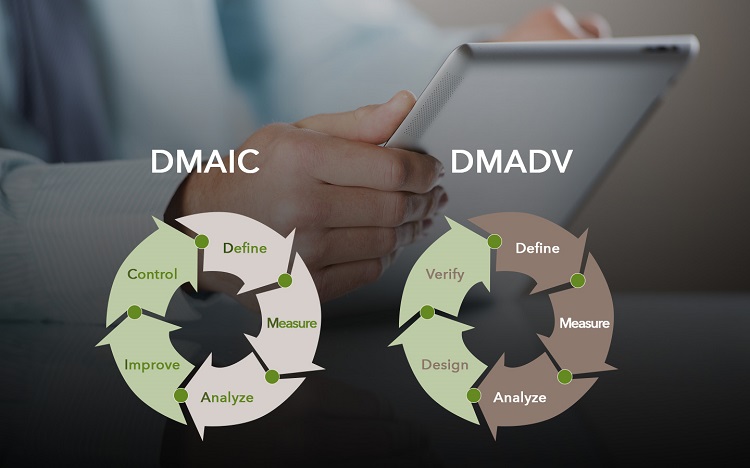
DMAIC is a part of the six sigma program which stands for Define, Measure, Analyze, Improve, and Control. DMAIC is a business strategy used to figure out how to improve processes while controlling costs.  It’s an effective way for identifying the root cause of significant problems within your operations or the surrounding environment and then leveraging that knowledge to create a plan to solve it.

1. Define : First make sure that you have an objective in mind for what you want to improve and understand the problem as much as possible; this will help determine which process is being improved.

2. Measure : Next establish a baseline from which you can measure improvement by collecting data before any changes are made. This might involve making a control chart or collecting data from past projects/work because it contains groups of similar problems.

3. Analyze : After you have accumulated the data, analyze it to see what you can do to improve and get a baseline figure. This is a good time to use Control Charts and Pareto charts to see what improvements are occurring and which ones need more improvement.

4. Improve : At this stage you should begin making changes that will improve your process. One of the most important factors is changing system thinking in terms of getting rid of bad habits and creating new good habits. This part of the DMAIC cycle is for continuous improvement in your company and overall health of the system.

5. Control : After you have made all of the improvements, look at the data again to see how much it has changed and if there are any fluctuations or trends in your data. This will show you if you need to do more or less of something that you implemented.

2. DMADV :

DMADV is a part of the six sigma program which stands for Definition, Measurement Design Analysis Verification. These are general tools in the design process that we have found can be helpful to learn more about what is going on with your project.

The five phases are  :

1. Definition : The definition stage is when you establish a common understanding of how the design will be performed.

2. Measurement : The measurement stage is when you collect data that helps you understand how your project is unfolding.

3. Design : The design stage is when you leverage all of the information collected in order to make wise decisions about the next steps you may take. The information that has been collected can be seen as an opportunity to drive the project to a better outcome rather than being viewed as a source of risk.

4. Analysis : The analysis stage is when you take all of the information collected in step 2 and step 3, and perform an analysis on it to help you understand what is really happening with your project.

5. Verification : The verification stage is when you compare expectations of how you want the project to unfold with how the project is actually unfolding. By doing this comparison, you are verifying that your original intentions are being met.

When to use ?

1. DMAIC : DMAIC methodology is used when the product has already been released out of the company, however there are issues or the product deviates from the customer’s demand.

2. DMADV : DMADV methodology is used when the product is not built and is currently in the designing & planning process. It is also used when the product could not be optimized and needs to be rebuilt.

Difference Between DMAIC and DMADV :

DMAIC DMADV 
DMAIC is about the improvement and control process. It defines the business process. Find problem then solve it in a target of providing improved solution.  The design and verification process involves the redesigning of the whole process to come close to the requirement described by the customer.
It addresses the current processes of the project.  It addresses the design processes of the projects. 
It works better with pre-existing projects.  It works better with new projects. 
It is about minimizing the processes and correcting the errors.  While it is about preventing errors. 
It uses quantitative tools.  It uses qualitative tools 
DMAIC are usually considered for short term projects.  DMADV are usually considered for long term projects. 
DMAIC gives specific solution.  DMADV is not the whole solution process, it is a part of the design solution. 
It is about correction.  It is about prevention. 
DMAIC controls future process performance.  DMADV verifies the design performance. 
It is initiated from a problem.  While it is initiated from an innovation solution. 

Source: geeksforgeeks.org

Thursday, 19 November 2020

Go Ahead in Your Career with A Six Sigma Certification

six sigma, six sigma tools, six sigma green belt, six sigma black belt, six sigma yellow belt, six sigma certification

The Six Sigma Process

In most straightforward terms, the Six Sigma process is a quality control program. When it was developed, its goal was to reduce manufacturing defects and improve cycle time. Over the past several decades, the plan was used to address a broader range of general business needs, such as maintaining and enhancing business products and services, increasing customer retention, and better meeting customer demands.

In more advanced terms, the goal of this process is to make analytical improvements to business processes. It decreases focus on qualitative markers in qualitative measurements of success-thinks project management, financial analysis, and statistics.

Success is seen as efficiency, known as a business process with less than 3.4 defects or problems, anything that does not meet the consumer, per one million chances. At its core, a Six Sigma process advocates that all business methods can be optimized through measurement.

How to Get Six Sigma Certification?

Six Sigma is a quality management methodology that enhances process outputs by identifying and eliminating the causes of defects and minimizing business variability.

1. Consider the Needs of Your Organization

It would be great if you first analyzed what Six Sigma certification is best for you. Is it bearing from too much wastage in the supply chain?

2. Decide on How You Need to Optimize Your Processes

You should optimize the process continuously. On the other hand, you might be someone who opts for the stress on performance or providing a quality product with a little waste.

3. Determine Whether You Require Six Sigma or Lean Six Sigma

It would be best if you chose according to the terms of your environment. It would be best if you opted for what you need. Six Sigma defines waste as a change within business processes. If you are someone who believes inconsistent processes, you have to be compatible with this process.

Lean is a blend of Lean methodology and Six Sigma. It defines waste as such things that do not add value to the finished product. If you are looking for an emphasis on efficiency, you should go for Lean Six Sigma.

What Does the Six Sigma Hierarchy Do Inside the Organization?

Black Belts keep all team members on the course to reach goals and deadlines. Their first task is project management; they are the individuals who define a project and its reach.

Green Belts are Professionals who run strictly under Black Belts, accountable for doing most of the data collection. Green Belts usually are employees of an organization who also have other day-to-day responsibilities within that company's framework.

The Yellow Belt designation refers to employees with basic training in quality improvement methodology and who participate in related projects. They have a basic understanding of the method and assume a supportive role to Green and Black Belts within a Team.

During a company-wide Implementation, specific issues and problems may occur. Experts like Master Black Belts can better resolve issues that come along and offer appropriate solutions to teams.

Regardless of your organization’s size or industry, the method can improve your internal processes and drive better outcomes. This strategy relies on the people who implement it, creating excellent leadership development opportunities among your staff. So, while it might not be a supersecret martial arts fraternity, still packs quite the punch.

What Are the Six Sigma Career and Salary Prospects?

It is a big way to climb up the career ladder with cool job titles and to match salary possibilities. Companies that routinely hire candidates to fill Sigma Six positions include Abbott Laboratories, General Electric, The Hershey Company, Newell Rubbermaid, Siemens, and Wells Fargo.

Six Sigma professionals have several career choices as manufacturing engineers, agreement engineers, and working system specialists.

Additionally, there are career opportunities with the following titles, although the correct terminology can vary from company to company:

  • Six Sigma Analyst
  • Six Sigma Black Belt
  • Six Sigma Consultant
  • Director of Operational Excellence
  • Functional Project Lead
  • Senior Project Manager
  • Six Sigma Projects Manager
  • Business Process Manager
  • Lead Analyst/Project Manager

In terms of salary, a Six Sigma Green Belt certified can expect an average yearly salary of $71,019 per year.

Conclusion

Each of the Six Sigma and Lean tools can be used independently or in conjunction with another to maintain a business achieve quantifiable goals. Most companies that adopt these tools enjoy measurable results in quality improvement, staff engagement, cost savings, and customer satisfaction.