Friday, 13 December 2019

Taking Advantage of Computer-Based Analysis for DFSS

The goal in product design or business process engineering is to create products or processes that are insensitive to the sources of variation that inhibit their intended function. The design phase in the product development process is a crucial activity since this is when most downstream production and quality problems are locked-in. As a consequence, a successful DMAIC (Define, Measure, Analyze, Improve, Control) Six Sigma program may evolve into what is known as Design for Six Sigma (DFSS).

DFSS integrates marketing, engineering and production information into the design world. DFSS focuses on preventing defects by optimizing a transformation of customer needs into what can be produced in engineering and the process domain. Therefore, DFSS starts by defining a problem in the customer domain to understand the voice of the customer (VOC) and the customer’s use of the products or transactions. Models must then be developed in the engineering or process domain with the help of functional parameter diagram and quality function deployment (QFD)-like techniques. The model must be a translation of the voice of the customer into a system that can be engineered. Understanding design variable interactions and sensitivity of system performances relative to system variables is the ultimate goal of this step.

Having understood the behavior of the system, the next steps are to find optimal and robust solutions and then verify the solutions in customer and production conditions. Typically, DFSS deals with multiple objectives in the optimization step and then stack-up tolerance analysis and degradation or key life testing in the verification step. Robustness and optimal solutions will ensure the product meets the customer’s intended use and is delivered on time and at a lower cost – eventually improving the company’s profitability.

Complexity and Pace Demand Use of Computer Analysis


Complexity of the product or process and the fast-paced schedule to bring the product to market demands that DFSS takes advantage of computer-based analysis. Computer-based analysis needs analytical (either mathematical or simulation) models called transfer function and analytical optimization. Transfer function can be derived from the first principle of physics, engineering drawing of stack-up processes, finite element method-based simulation such as computer aided engineering (CAE), regression analysis of empirical or observational data, and/or response surface from computer experimental designs. When the analytical models do not include comprehensive noise factors such as piece-to-piece variation, changes in dimension or strength over time/cycle, customer usage and duty cycle, external operating environment, and internal operating environment /interaction with neighbouring subsystems, they can be represented by the variability of the existing variables or parameters in the models.

The goal of computer-based experimentation is multiple. One goal is to develop simple approximation that is fast to compute and accurate enough within a certain design space, especially for time-consuming CAE models. Computer-based experiment logistics are often straightforward so that relatively large number of runs may be feasible and parameters can be adjusted in software. A large number of runs allows variable sampling over many levels instead of just fewer runs with limited variable sampling, e.g., two or three in hardware experimentation. Multi-level sampling can capture high order and nonlinear models. Since responses from computer are deterministic, there is no random error, and replication and randomization do not have value. Therefore, flexible alternatives to standard arrays, e.g., uniform design and Latin hypercube designs are suitable to running computer-based experimentation.

Illustrated here is a step-by-step process for executing analytical or computer-based DFSS. This includes identifying voice of the customer, translating VOC to critical-to-quality characteristics (CTQ) using QFD, modeling system transfer function using engineering drawing, finding optimal and robust solutions using graphical approach and mathematical programming based on computer experimentation, and finally indicating tolerance design approach. The case study shows how to find optimal and robust designs of a sliding door. The study can be run using available commercial software. This example can be easily adapted to different product design and business process engineering, including transactional products and processes. The essential difference between engineering and transactional processes is that natural laws, such as conservation of energy or mass, govern engineering and manufacturing processes, but man-made laws, such as regulations, govern transactional processes.

Step 1. Identifying VOC


The first step is identifying the customers’ needs. In the case of the sliding door, customers’ desires have been found to be:

◉ Good value
◉ Reliable and durable design for various materials and conditions
◉ Low noise and rattle level
◉ Ergonomic features, easy to use with minimum effort to open
◉ Safety features to prevent accidents

Step 2. Translating VOC to CTQ


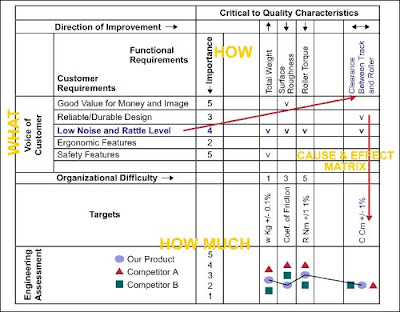
QFD in the form of house of quality translates VOC to CTQ. The house of quality below shows that noise and rattle level is related to the clearance between track and roller of the door. When the clearance is too big, the rattle level will increase, but when it is too tight, the noise level will increase.
Six Sigma Study Materials, Six Sigma Tutorial and Materials, Six Sigma Learning, Six Sigma Online Exam, Six Sigma DFSS

Figure 1: House of Quality Helps Get to CTQ

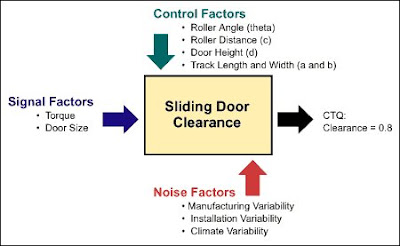
The detailed functional relation between design variables or parameters (signal, control and noise factors) and the system performance or CTQ, i.e., clearance, is captured in the parameter diagram.

Six Sigma Study Materials, Six Sigma Tutorial and Materials, Six Sigma Learning, Six Sigma Online Exam, Six Sigma DFSS

Figure 2: Parameter Diagram

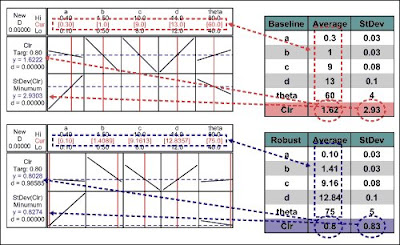
The baseline design, i.e., a = 0.3 with StDev = 0.03, b = 1 with StDev = 0.03, c = 9 with StDev = 0.08, d = 13 with StDev = 0.1 and theta = 60 with StDev = 4, gives clearance = 1.6 with standard deviation = 2.9. The objective to get a low noise and rattle level is clearance = 0.8 with as low standard deviation of the clearance as possible.

Step 3. Modeling System Transfer Function


Let P be the set of control factors (a, b, c, d and theta), M be the signal factor (torque, door size), Z be the set of observable noise factors (variability of a, b, c, d and theta). The signal can be considered as a part of noise factors, if it is fixed at one value. Let Y be the system performances, i.e., clearance (Clr.). Assume the system follows an additive noise model, i.e., the location-dispersion or mean-variance model as follows:

Y = f (P,M,Z) + e

f(.) is the deterministic performance mean derived from the first principle of physics, engineering drawings, regression or response surface methods. is the random error caused by the uncontrollable noise factors whose expectation and variance are E (e) = 0 and variance (e) = s2(P,M,Z), respectively. In many cases, the variation of e (or the performance variability) is close enough to the variance of linear approximation of Y since the linear approximation of Y is around the small area between its mean and variance.

Since the computer experimentation output is deterministic, the performance variability, i.e., standard deviation of clearance, can be estimated through Taylor series expansion of f and the variance of each design variable at a neighborhood of a certain fixed value of the design variables, x:

Six Sigma Study Materials, Six Sigma Tutorial and Materials, Six Sigma Learning, Six Sigma Online Exam, Six Sigma DFSS

For x is a set of design variables or parameters or factors. Approximation of sy is “good” when y is approximately linear in a 2s– -3s neighborhood of x.

Robust design can be obtained by minimizing the performance variability, i.e., s2y. This can be done by either minimizing the sensitivities, i.e., derivatives of f(x), or minimizing variability of design variables, i.e., sx1, …, sxn. Optimal design can be obtained by selecting nominal values of other certain design variables, i.e., x1, …, xn, to bring the system performance mean to its target. Minimizing design variables or parameter sigma by improving process capability is mainly part of DMAIC Six Sigma.Minimizing the sensitivities by selecting nominal values of design variables,i.e., x1, …, xn, is mainly part of DFSS.

Following the mean-variance model above and applying vector loop technique for stack-up analysis, the transfer function of the clearance and its variance can be derived as follows:

Clr. = d – c – 2(b + a/tan[q]) and s2(Clr.) = s2(d) + s2(c) + 4s2(b) + 4s2(a)/tan2(q) +4a2 Secan2(q)/ tan2(q)

Step 4. Finding Optimal and Robust Design


Finding the best setting of certain design variables can minimize performance variability and others than already-chosen design variables can adjust performance mean to target. This kind of approach was originated by Dr. Genichi Taguchi.

Design of Experiments – Choosing design space and number of levels or settings of the design variables in experimental design need to include engineering and production knowledge. The baseline and benchmark values also should be considered in choosing the design space. To explore high order interaction effect or the nonlinearity relationship between a specific design variable and its system performance, there is a need to choose more levels of that variable as for variables a and theta. The standard deviation of each design variable should be obtained from a stable and under-control process.

Then an appropriate experiment matrix is created. With analytical expressions of the system performance and its variation in hand, the outputs of the experiment are obvious. In this case, a full factorial design generated from DOE Pro XL or Minitab is applied and then the values of Clr. and its standard deviation using their explicit formulas in MS Excel are generated.

Global Sensitivity Analysis – Having generated experimental output, the next step is to analyze the sensitivity of Clr. and its standard deviation in relation to the design variables on their chosen design space. Global sensitivity analysis is very important to rank the importance of the design variables, especially in sequential design of experiments to identify the effective design variables included in design. Analysis of variance (ANOVA) is one tool to get the global sensitivity of the system performance, as shown in the table below.

Analysis of Variance (ANOVA)

Clearance
Source SS  df  MS P % Contrib.
a 10.7000 3 3.6000 0.0 00.96
b  360.0000  2  180.0000  0.0  32.39 
c  360.0000  2  180.0000  0.0  32.39 
d  360.0000  2  180.0000  0.0  32.39 
theta  17.2000  4  4.3000  0.0  01.55 
AE  3.4487 12  0.2874  0.0  00.31 
Error  0.0000  514  0.0000  00.00 
Total  1111.3980  539 

Standard Deviation (Clearance) 
Source SS  df  MS P % Contrib.
a 638.400 3 212.8 0.0 86.63
b  0.000 2  0.0 1.0 00.00
c  0.000 2  0.0 1.0 00.00
d  0.000 2  0.0 1.0 00.00
theta  82.100 4  20.5 0.0  11.14
AE  16.500
12  1.4 0.0  02.24
Error  0.000 514  0.0 00.00 
Total  737.013 539 

The ANOVA table shows that a and theta have about 98 percent influence to minimize performance variability (StDev[Clr.]) and b, c and d have about 97 percent influence to optimize the performance mean (Clr.). Small interaction between a and theta occurs to both of the performance variability and mean.

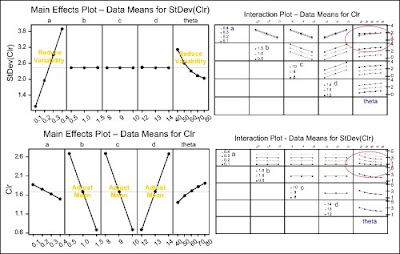
Graphical Approach – The direction to find the best settings of the variables are shown through the main effect and interaction plots of the experimental results as shown in Figure 3, obtained from Minitab.

Six Sigma Study Materials, Six Sigma Tutorial and Materials, Six Sigma Learning, Six Sigma Online Exam, Six Sigma DFSS

Figure 3: Main Effects Plot

The plots indicate that decreasing a and increasing theta will minimize performance variability, and selecting settings for b, c and d will adjust the performance mean to target, but they do not affect the performance variability. This approach is called graphical approach. (In order to optimize the baseline design to its target, without considering robustness, it would be intuitive to increase a and decrease theta. This would get an optimal solution, but the solution would not necessarily be robust.

Mathematical Programming Approach – Graphical approach cannot provide an easy way to find optimal and robust solutions when there are multiple performances or the interactions among the design variable are significant. In such situations, what needs to be applied is a mathematical programming approach, e.g., dual response optimization for performance mean and variability problems, or desirability function method-like approaches for multiple performances.

Dual response optimization is to minimize StDev(Clr.) subject to clearance on target and the design variables in design space. This can be implemented by using add-in MS Excel Solver.

In many cases each performance has different magnitudes. One way to normalize each performance into values between 0 and 1 is to implement desirability function method. Optimizing clearance is to find its best nominal values. Optimizing (Clr.) is to minimize (Clr.).

Once performances are converted into individual desirability that has values between 0 and 1, weighted geometric mean aggregate methods may be used to combine the individual desirability. Finally, optimizing the aggregate value is equivalently to optimizing each individual performance, i.e., clearance and its standard deviation. Multiple objective optimizations will generally end up with what are called Pareto optimal solutions. These solutions are suitable to satisfy a family of products whose performance targets are various.

The baseline design results compared to the optimal and robust design results using Minitab Optimizer which is based on desirability function method are shown in Figure 4.

Six Sigma Study Materials, Six Sigma Tutorial and Materials, Six Sigma Learning, Six Sigma Online Exam, Six Sigma DFSS

Figure 4: Design Results — Baseline, Optimal and Robust

The robust design gives performance mean close to the target, i.e., 0.8 with the performance variability only 0.83. The design is robust more than 3.5 times than the baseline design. Moreover, the robust design relaxes the theta tolerance from StDev = 4 to StDev = 5.

Guide for Manufacturing and Quality Process – From the equation of the variance of y for a point x0 above, the local sensitivity of the design variables is defined as:

Six Sigma Study Materials, Six Sigma Tutorial and Materials, Six Sigma Learning, Six Sigma Online Exam, Six Sigma DFSS

Six Sigma Study Materials, Six Sigma Tutorial and Materials, Six Sigma Learning, Six Sigma Online Exam, Six Sigma DFSS

Figure 5: Local Sensitivity of Robust Design

The local sensitivity of the robust design using Crystal Ball v.7 is given in Figure 5. This shows that roller distance (c) and door height (d) are the most sensitive variables in relation to the system performance mean, as their influence on clearance is as much as 80 percent. Track length (a) and roller angle (theta) are the only influential variables to the system performance variability. Those results can be applied as early identification to allow, e.g., quality assurance people to focus on variables c and d in their control process, and manufacturing or supplier people to plan for variables c and d in their facility and tooling up front.

Robust design also identifies that variables a and theta have minimum influence on optimal performance mean. Therefore, the tolerance of both variables can be relaxed without loosing significantly the optimal and robust design.

Monte Carlo Simulation – In the case, with the explicit transfer functions of clearance and its standard deviation, the distribution of the design variables is known, i.e., normal. With this information, Monte Carlo simulation software can be used to find the best setting of the design variables for robust design.

Step 5. Tolerance Design


The process shown above can be repeated to get the optimal tolerance for each design variable. This is about how to economically allocate the performance tolerance to the tolerance of the controllable and uncontrollable variables. The algorithm is to fix the design variables at values to get the optimal and robust design and then to change the deviation of the variables.

Thursday, 12 December 2019

Achieve Your Goals with PRINCE2 Practitioner Certification

PRINCE2 certification talks about project management standards and hence are quite helpful in various industries. Adopting the PRINCE2 certification can help in improving the knowledge of the practitioner, and thus the demand for such a practitioner rises to a great extent in the industry.
PRINCE2 Practitioner, PRINCE2 Practitioner Certification, PRINCE2 Practitioner Exam, PRINCE2 Practitioner Exam Questions, PRINCE2 Practitioner Project Management
As per a research, it has been observed that the practitioners who have completed the certification of PRINCE2 have an earning somewhere around $90,000.

What is PRINCE2 Practitioner?

PRINCE2 Practitioner is the second line of the PRINCE2 qualification scheme. Whereas the PRINCE2 Foundation certificate is designed as a basic introduction to the PRINCE2 project management framework and is fitting for anyone wishing to work in a project environment, the PRINCE2 Practitioner qualification demands a knowledge of how the PRINCE2 method should be used on actual projects and is intended for individuals seeking to work as project managers.

PRINCE2 Practitioner Certification

  • To suit the wants of your project, you can customize the principles.
  • You are now eligible to manage a team using the PRINCE2 method as a Practitioner.
  • It helps in demonstrating the practical knowledge of completing projects using the PRINCE2 method.

PRINCE2 Practitioner certification requirements:

Learn about the requirements for PRINCE2 practitioner level certification:
  • Project Management Professional (PMP) or Certified Associate in Project Management (CAPM).
  • IPMA Level A/B/C/D.

What Can You Learn in PRINCE2 Practitioner?

  • Before starting, it is essential to know about the things in detail that you can learn through practice.
  • Starting and closing of a project in a controlled way with the aid of the principles of PRINCE2,
  • Making progress reviews of the project as well as the business cases,
  • Giving free communication between the stakeholders and the management,
  • Breaking down any project in parts for better management,
  • Learning the method of delegating, monitoring, and controlling.
  • As well as appearing in the official register of PRINCE2 Practitioners, successful PRINCE2 Practitioner candidates can include ‘Registered PRINCE2 Practitioner’ on their business cards to indicate their competence and understanding of the PRINCE2 project management framework.

Being a PRINCE2 Practitioner Can Help You Achieve A Project Management Role

If your final goal is to work as a project manager, PRINCE2 is a highly useful certification to have on your CV: this is true if you already have project experience and can be again true if you are coming from a different career background. As a practical matter, investing in PRINCE2Certification is simply a need if you are looking to enter into a project management role without any previous experience.

It will teach you sufficient for you to know the basic principles and duties of your position, and it will also make you a more compelling candidate for employment than if you had applied for a project control position with no experience or knowledge of what the job would entail.

Just be informed that you may not be fascinated with the methodology initially. Many project teams find PRINCE2 too determined for their types of projects. However, becoming qualified in PRINCE2 offers available possibilities to elaborate on your experience and make the methodology more critical to your industry and projects.
PRINCE2 Agile is a qualification that is an increase of the PRINCE2 Practitioner exam, which mixes elements of PRINCE2 and the very flexible methodology Agile Project Management. For some project managers, paying for two or three certifications to learn the proper methods may not seem like a good investment, which is something you would need to think about before you consider enrolling.

Conclusion

Almost every business, every sphere today, uses the PRINCE2 Project Management principles. Just imagine how wonderful it would be a skilled professional with PRINCE2. If you are an expert in Project Management, you will move from victory to victory.

Wednesday, 11 December 2019

8 Essential Project Management Skills

Project Management Skills, Project Management, Project Management Guides

The first logical step in starting a career as a Project Manager is to gain a trusted and accredited project management certification such as PRINCE2. AGILE, MSP or PMP. This will show that you have gained an understanding of how a project is run and will boost your chances at being hired. This may, however, not be enough to prove yourself as a well-rounded Project Manager as there is much to be said about the essential project management skills that may not be taught during your educational training. This is where the difference between knowledge and skill becomes evident.

Technical Skills


1. Managing Your Resources

Resources are usually seen as equipment or money that needs to be allocated to the right individuals or teams at the right time. But an often overlooked resource is the individuals that make up your project teams. Ensuring that each team member knows what to do and when to do it is of the utmost importance, but you need to ensure that the right person is doing the work that they are trained to do.

Each team member will have a certain specialisation and forcing them into an unfamiliar role can cause confusion and will almost certainly see that employee’s morale drop. This can have a serious negative effect on the work being done and will, ultimately, effect the overall quality and progress of the project.

2. Managing Risk

It would be superfluous to expect a project to run perfectly from start to finish. Every project has it’s own unique risks and challenges that will either be known at the beginning of the project, or will be realised as the project progresses. The difference between a good Project Manager and a great one lies in the way that risks are managed.

As risks arise, it is best to keep calm and decide which course of action is to be taken in order to ensure the risk is properly planned for. Gather suggestions from your fellow project workers, draw up a plan of action and stick to it. Putting value in the input of your project team will show them that you respect their skills and knowledge and understand that you cannot run a project by yourself.

Project Management Skills, Project Management, Project Management Guides

3. Managing Schedules

Your project schedule is one of the most important tools that you will use during a project. It contains all the information you will need to delegate the tasks that need to be completed – and when they need to be completed by. It is essential that each task is started on time by the person that the task has been allocated to.

This extends into keeping track of each task. The progress of work being done needs to be monitored to ensure that the deadlines that you have established are met. Failure to do so can cause the project to fall behind and cause issues where they could’ve been prevented.

4. Managing Change

There is a very good chance that change will come about when working on a project. You may need to adjust your expected time of delivery, there may be changes that are requested by the customer or you may need to adjust your project plan due to an unforeseen circumstance.

Changes that need to be made, or are requested, need to be recorded and decided upon. Ensure that you are aware of the impact that the change will have on the overall project and what steps will need to be taken to ensure that the project stays on track. Once this has been documented, a decision will be made by the project board, or the equivalent authoritative figure.

Soft Skills


5. Stay Organised

The sheer amount of information that goes along with running a project can be overwhelming and, if left unchecked, can become messy and disorganised. This can cause detrimental problems to your project as you need to have every bit of information easily accessible and well-organised.

When your information is kept organised, it becomes mush easier to measure the intended progress of the project versus actual progress, keep track of tasks that are being completed or need to be started and to ensure that everyone involved in the project is kept up to date with their individual tasks and responsibilities.

6. Communication

One of the most important soft skills that a Project Manager needs to master is being a good communicator. Without proper communication, chaos can quickly ensue and cause irreversible damage to the project. The ability to relay important information will ensure that your project team is kept in the loop when there are changes that need to be made, when they need clarification on an issue or keeping everyone up to date with the project’s progress.

But communication works both ways. Being a good listener can be invaluable when working with other project professionals. Someone in your project team may have a solution that you haven’t thought of, or they may have a suggestion that will help the project move forward at a faster rate. This will also help your project team understand that their opinions aren’t shrugged off and could actually make a difference.

7. Be a Leader

Bringing leadership into your management style could make a massive difference to the respect that you earn as a Project Manager. There are many Project Managers that are happy to delegate project tasks as they arise. This is not an ineffective management style, but it can make the Project Manager seem uninvolved and unapproachable.

Being a leader involves more than barking orders. A true leader will do just that – lead by example. Being involved in the every day running of the project without hindering the work that is being done will not only show that you have a hands-on approach to management, but will ensure that you have a better understanding of project progress, issue management and will show your project team that you are not afraid to get your hands dirty.

8. Keep Calm

Being a Project Manager very often means that you will be working under pressure, with lurking deadlines, ensuring the quality of the finished project, reporting to your superiors – all whilst making sure that the project remains on it’s intended track. With so many factors to consider, there is a good chance that something will go wrong somewhere down the line.

Keeping a calm, collected demeanour will make all the difference in this situation. It is never a good idea to lose your temper or become flustered when you feel that you are overwhelmed. The best solution will be a well thought out one, rather than a decision made in haste and panic.

Monday, 9 December 2019

Safeguard Against Four Forms of Six Sigma Opposition

Over the years, I have had numerous inquiries from readers about overcoming opposition to Six Sigma. Interestingly enough,  have also experienced this opposition when speaking with prospective or existing clients, some of whom have asked me not to mention Six Sigma but to speak to tools in a generic fashion. Obviously, opposition to the method has become a common deployment obstacle.

Six Sigma Study Materials, Six Sigma Guides, Six Sigma Certifications, Six Sigma Learning, Six Sigma Online Exam

Practitioners typically encounter four types of resistance to Six Sigma: technical, political, organizational and personal. In order to resolve this negative force, they must classify the type of opposition they are encountering, understand its root cause and then adjust their deployment strategies accordingly.

History of the Push Back


In the late 1990s and early 2000s there was a growing consensus that Six Sigma was not a “flavor of the month” process improvement methodology. It had crossed over from manufacturing to service industries, including the financial and healthcare industries. Adoption was relatively high, and opposition low. Companies were delighted with the methodology’s accomplishments and sustainability. But recently stakeholders have become more cautious of using the Lean and Six Sigma terminology, tools and methodology.

While the terminology may be intimidating, Lean and Six Sigma tools have brought much success to corporations. Therefore, practitioners must work to overcome this fear. To do this, they must investigate the root cause of the opposition.

Change Should Not Equal Loss


The root cause of opposition can be seen in an exercise featured in the article “The Change Game: Engaging Exercises to Teach Change.” To play, participants are asked to change things about their physical appearance. Surprisingly, people often begin by taking off pieces of jewelry or clothing. During the post-game debrief, participants note a strong tendency to think of change as a loss – they must lose something in order to change.

If change is somehow equated with loss, how can practitioners expect any Lean Six Sigma program to be successful? The answer is to identify, motivate and mobilize their teams in order to increase commitment and eliminate the fear of loss. This can be accomplished through a stakeholder analysis.

Completing a Stakeholder Analysis


Stakeholders control critical resources or own key processes impacted by change. They have needed expertise. They are influential in how other critical stakeholders think. They can block projects – directly or indirectly – and must approve certain aspects of those projects. It is important to identify key stakeholders or those stakeholders who have leverage or influence over other stakeholders. Once identified, practitioners should document each stakeholder’s current level of support or opposition to the quality initiative.

There are five possible levels of stakeholder support:

◉ Strong Support – Advocates for making things happen

◉ Moderate Support – Those who may only be involved in helping with the Six Sigma initiative. They do what they are asked to do and nothing more.

◉ Neutral – Those who are merely letting things happen. They are not proactive advocates of the initiative, nor are they out to sabotage it.

◉ Moderately Against – Those who will not comply with what is asked of them

◉ Strongly Against – Not only do they not comply with the efforts underway, but they also go out of their way to lobby against the change initiative.

Table 1 shows one of many examples of a stakeholder analysis. The five categories of support are listed across the top of the chart, while stakeholders are listed down the left-hand side. An “O” represents the stakeholder’s current support for the initiative, and an “X” represents where the stakeholder’s support needs to progress to in order to successfully complete the initiative.

Six Sigma Tutorial and Materials, Six Sigma Guides, Six Sigma Study Material, Six Sigma Online Exam

Table 1: Stakeholder Analysis

Practitioners do not always need strong support from every stakeholder; however, all stakeholders need to be aware of the change because neutral or moderate support may indicate that they do not know of the initiative. Practitioners should document the plan or actions required to bring the respective stakeholders up to the required level of support (Table 2).

Six Sigma Tutorial and Materials, Six Sigma Guides, Six Sigma Study Material, Six Sigma Online Exam

Table 2: Stakeholder Analysis with Action Plans

Types of Opposition


In most cases, none of the stakeholders will be where practitioners need them to be to ensure the success of the initiative. Many may be neutral because they have not heard of the initiative. Because of these factors, practitioners likely will encounter at least one of the four forms of opposition.

Technical Opposition

While I’m really good with PowerPoint animations and can maneuver myself around a database, I admit I am not a wizard with the computer. Most of my technical skills are either self-taught or from observing best practices of my peers. While I want to be an expert at everything, that is not always possible. So, why do I occasionally express opposition to technical aspects? Because I do not want to feel inept. That which is not often understood is typically resisted. Although I pride myself with my accomplishments and deliverables, the computer at times makes me feel insufficient.

This scenario applies to participants implementing Lean Six Sigma initiatives. The methodology is commonly associated with statistics, which can make people feel inept. Many Master Black Belts are trained statisticians who rely more on theory than application.

How to Overcome – In the case of technical opposition, it is vital to eliminate theory and concentrate on training the basics. Make concepts easy to understand by providing real-life examples. Encourage participant confidence by building on their own examples and experiences.

Political Opposition

Politics are present within most organizations, and they need to be understood and dealt with accordingly. A former client had a senior manager participate as a stakeholder. This senior manager was extremely intelligent and had a proven track record for her style and approach in getting things done. Unfortunately, she was vocally opposed to the Lean Six Sigma deployment from Day 1 and said she would do the best she could to get the program cancelled and eliminate the need for my team.

It was extremely difficult not to take this as a personal attack. But I understood this as merely political opposition. Political opposition exists when a change is seen as a threat to the status quo. This individual was comfortable using concepts that she believed in and now someone had come in and expected her to do things differently – perhaps affecting her success.

How to Overcome – Political opposition can stem from real or perceived loss on behalf of an individual. Practitioners should distinguish between what is real and what is perceived, and then work quickly to provide reasoning as to what can (and in most cases, will) be gained, versus lost, from the initiative.

Organizational Opposition

Like political opposition, organizational opposition involves the feelings of loss. The primary difference is rather than the loss being attributed to a person, it is attributed more to a group or department. Everyone wants to succeed and be recognized; however, when the recognition stems from factors outside of the organization – like a “never before attempted methodology” – egos can become bruised. A Lean Six Sigma initiative can give process owners the perception that they are no longer in the driver’s seat, making them feel unable to manage their business.

How to Overcome – When dealing with organizational opposition, recognize that it involves ego, a sense of ownership, control and pride. Extreme care should be given to ensure the involvement of process owners so that they are fully engaged and feel a greater sense of control in the improvement process.

Personal Opposition

I recently worked with a client who seemed in full support of Lean Six Sigma. She said all of the right things and did not present a negative viewpoint. However, the initiative timeline had fallen way behind and a six-month project was now nearing nine months. When asking what the client thought the holdups were, what barriers she was facing and how I could assist with their elimination, she addressed some personal, non-work-related challenges and situations. The root cause for some opposition may be extreme personal stress and fatigue caused by factors outside work.

How to Overcome – Be extremely empathetic with someone who exhibits personal opposition. As coaches, practitioners often find themselves acting as a sounding board for topics unrelated to Lean and Six Sigma. Practitioners should modify their behavior toward these individuals; lessen their workload but increase involvement with these people. Everyone benefits from a little compassion, patience and understanding.

Saturday, 7 December 2019

What is PRINCE2 Agile®?


PRINCE2 Agile® was released by Axelos in June of 2015 in order to bring together two of the great project management methods and to lend greater flexibility to projects. The course can at present be attended in classrooms in Australia, New Zealand, Europe and the UK.

There are many that believe the PRINCE2 and Agile project management methodologies are contradictory in nature. This is largely due to the myth that PRINCE2 is a traditional waterfall approach to project management when, in fact, this is nothing but a misconception. The fact is that PRINCE2 is still the de facto method for project management used by thousands of Project Managers and organisations all over the world. With Agile seeing a great deal of growth, there is now demand for PRINCE2 and Agile to be used in conjunction with each other, offering Project Managers the best of both worlds.

How will my organisation benefit?


Is it really worth it for organisations to train their staff in PRINCE2 Agile when they have already adopted one of the methods? Below we will look at the added benefits that your organisation can expect when adopting PRINCE2 Agile.

A wider focus

Agile and PRINCE2 are both considered to be leading project management methods. Given that PRINCE2 focusses on the project as a whole and Agile has a strong focus on delivery, the combination of the two methods will ensure that your organisation’s projects deliver quality products on time whilst giving the project the best possible chance at being successful.

Improved communication

The fact that the PRINCE2 and Agile terminology has now been consolidated means that your project staff will be able to communicate without the hindrance of misunderstood or confusing language, something that has led to the demise of a great deal of projects. Communication plays a massive part in project management, given that everyone involved in a project needs to know exactly what they need to be doing and when.

Flexibility

PRINCE2 is best known for the fact that it can be tailored to suit the needs of any project, in any industry and of any size. The flexibility that is added by incorporating Agile into PRINCE2 will see your projects enjoy even more possibilities where tailoring towards Agile’s delivery methods is concerned, ensuring that each project is treated on its own merit.

Return on your investment

Many organisations have invested heavily in staff training in either the PRINCE2 or Agile methods. They will now be afforded the opportunity to benefit from both methods without the need to invest in training in an added method but will instead reap the benefits of both.

What will this course teach me?


The PRINCE2 Agile Foundation and Practitioner course will enable you to:

◉ Understand the basic concepts of working in an Agile context

◉ Understand the purpose of combining PRINCE2 and Agile

◉ Implement and assess the focus areas to a project in an Agile way

◉ Apply (fix and flex) the six project aspects according to Agile

◉ Tailor the Principles, Processes, Themes and management products of PRINCE2 to a project in an Agile context

◉ Sit the PRINCE2 Agile Foundation and Practitioner exams with confidence

What about my previous certifications?

There are no formal academic prerequisites to undertake the PRINCE2 Agile Foundation course.

PRINCE2 Agile Practitioner takes into account, as a prerequisite, the following certifications:

◉ PRINCE2 Agile Foundation

◉ PRINCE2 Foundation

◉ Project Management Professional (PMP)

◉ Certified Associate in Project Management (CAPM)

◉ IPMA Level A (Certified Projects Director)

◉ IPMA Level B (Certified Senior Project Manager)

◉ IPMA Level C (Certified Project Manager)

◉ IPMA Level D (Certified Project Management Associate)

Individuals that hold any of the above certifications will automatically qualify to undertake the PRINCE2 Agile Practitioner course and the accompanying exam.

Exam information


The PRINCE2 Agile Foundation exam will be presented in multiple choice format consisting of 50 questions that are each worth one mark. The pass mark for the exam is 55% (28 out of a possible 50 marks). Students will have 60 minutes (1 hour) to complete the exam with no additional reading time allowed. It is a closed-book exam and no additional reading material will be allowed during the exam.

Also Read: Prince2 Certifications

The PRINCE2 Agile Practitioner exam will be presented in an objective testing format consisting of 50 questions that are each worth one mark. The pass mark for the exam is 60% (30 out of a possible 50 marks). Students will have 150 minutes (2.5 hours) to complete the exam with no additional reading time allowed. It is an open-book exam, allowing students to use their official PRINCE2 Agile guides throughout.

Friday, 6 December 2019

Using the 5As to LEAP into Lean Implementation

Six Sigma Tutorial and Material, Six Sigma Guides, Six Sigma Learning, Six Sigma Certifications

The implementation of the Lean way of dong business is approached in many ways in different types and sizes of organizations. Lean is not just a set of tools and techniques that can be learned from training or certifications session and then implemented in an organization to get the ultimate results. Lean is a culture that has to be developed over a period of time. The organization’s own quality system has to be practiced, standardized and continually improved upon with the stable, verified and validated processes to fulfill the customer requirements. The organization must prioritize value as it is defined by the customer.

Taking the LEAP Forward


A good acronym for the way an organization can implement Lean is LEAP:

Learn it: Know the requirement of the customer by understanding the customer and their requirements properly.

Explain it: Convert the customer requirements into technical details.

Adapt it: Convert the technical details into products through the stable, verified and validated processes of the organization.

Provide it: Provide error-free products to the customers at the right time, in the right quantity and at the right place.

Starting a Lean implementation in any organization requires the proper combination of two major approaches:

1. The technical approach: Learning the set of tools and techniques, and a bewildering array of terms (many Japanese) like kanban, andon, Takt time, level production, jidoka, muda, heijunka and so on.

2. The management approach: The process of leading and directing all of an organization through the deployment and manipulation of resources).

Six Sigma Tutorial and Material, Six Sigma Guides, Six Sigma Learning, Six Sigma Certifications

Figure 1: Approach Mapping

An unbalanced approach may lead to an unsuccessful implementation of Lean. While it is the management approach which helps build a Lean culture in an organization, both approaches are necessary. And both require considerable participation by both the organization’s leadership and its quality professionals. Both the approaches must be given due attention.

Move to Lean More Than Five Steps


Although here it has been divided into the five steps, in practice the Lean implementation is a continuous and ongoing process and is not limited by any boundary. The five steps can be termed the 5As – assessment, awareness, association, adherence and ascendancy.

Six Sigma Tutorial and Material, Six Sigma Guides, Six Sigma Learning, Six Sigma Certifications

Figure 2: 5A Cycle for Getting Started with Lean

1. Assessment: In the beginning, an organization needs to assess its present condition to know where exactly it stands before starting the culture of Lean. This is where leadership that leads is most vital. It is a frame to know exactly where the organizations wants to be in the future against the present state of condition. To know this, all the employees, starting from top to bottom, should be interviewed and/or assessed with suitable questionnaires. The analysis of this would come out with improvement action points for the organizations, comprised of things like technical and general training needs, process capability needs, management needs, quality management needs, etc.

2. Awareness: After the assessment is done and the analysis is completed, the total organization must be made aware of:

◉ Where the organization stands now.

◉ Where the organization is planning to go.

◉ Why the steps have been initiated.

◉ Who is the one that is leading the Lean implementation.

◉ What the timeline is for coming up to a particular standard.

◉ How the organization is going to lead up to the target.

◉ What the goals and objectives of the total projects are.

Here the leadership approach is a directive one and the chief executive leads the way in taking initiatives.

3. Association: Association is the step that is aimed at involving all employees in the organization in making the Lean implementation happen and making it a success. Association requires a coaching-type of leadership. Employees are coached on each aspect of the Lean process. The Lean training program is developed and the analysis of things like process capabilities, machine capabilities, human capabilities, worker knowledge, worker skill levels, soft skills like behavior and attitude is thoroughly assessed. This is often outlined as the 4Ms (man, machine, method, material), each of which need to be evaluated in terms of both soft and hard skills/capabilities. Each has impact on total process capability.

4. Adherence: Adherence does not just happen or take place by itself, it is built. Here a participative leadership style is more important. Everybody in the process must understand that they are an important part of the Lean movement. They must have considerable input into the process or they will not commit to the drive for excellence.

5. Ascendancy: Ascendancy toward ownership of the organization’s process improvement culture is the natural progression in the Lean process. It happens as people become empowered to improve the organization, see the suggestions they make paying off in improvement and then realize recognition for their efforts. Here in this stage, ascendancy is developed through the delegative leadership style.

Wednesday, 4 December 2019

Search Results Web results Lean Tools for the Novice

Six Sigma Tutorial and Material, Six Sigma Certifications, Six Sigma Learning, Six Sigma Online Exam, Six Sigma Study Material

Techniques and processes developed in the Toyota Production System, often called Lean, can be of great value in office environments. A focus on manufacturing, jargon and statistics have hindered the adoption of these tools in other settings where they can be useful. Non-Lean experts should take full advantage of simple, yet powerful tools to boost their organization’s performance.

Using Lean in Offices


There are several Lean tools that have great applications in office settings. Everyone has processes in their line of work. You may not have a vehicle manufacturing process, but you have a hiring process, a monthly closing process or a purchase order process – and Lean tools can help you improve.

With every process you work with you have two constant challenges – time and money. In any environment you are under pressure to do things faster or cheaper. I’ve spent most of my life chasing time and money, and I now think those things are two sides of the same coin. Time really is money.

The Lean tools I have focused on in my office life are process flow mapping, waste and bottleneck analysis, the 5 Whys, and visual controls. These tools are all simple to use and have – in a variety of situations – produced surprisingly significant results.

If you take a course in process flow mapping you will learn an excellent and detailed process you should use. It will involve shapes used for each step in your process to identify if that part of the process is a transformation step or a waiting step or whatever. I never felt like remembering all the shapes, but I like the idea of having a visual description of the current process. Understanding how things are done in a visual form (or seeing the “as-is state” in consultant speak) is a great starting point for improvement.

My experience is in human resources. What follows are a few examples of how we used process mapping and a few other tools to make improvements – all without being experts in Lean.

Improving Onboarding Process: Removing a Bottleneck


“Nothing focuses the mind so much as the prospect of an imminent hanging” is a quote I read someplace; I’ve had some times in my life where it’s been clear that if I could not fix a problem my new job title was going to be “applicant.” One time my company was cursed by excellent business results. Our sales were exploding and my group, which was responsible for recruiting and onboarding, became the bottleneck holding the business back from greater success because we were taking too much time to identify and onboard new hires.

Process Mapping

We decided to map our end-to-end process, identify each step and look for improvement opportunities. This is not too difficult to do if you get the people who understand the process involved together for a half-day or full-day – and buy food. (Food is the key element to most successful workshops, because it makes people involved less grumpy and people try to play along when you’re buying treats for them.)

We began by creating a visual map of each step of the hiring process. When that was complete, we discussed time and money using a simple Pareto analysis. Pareto was an economist who theorized that 80 percent of your benefit arises from focusing on 20 percent of your opportunities (or something like that). In other words, focus on the big hitters and skip the small stuff. If you’re doing a process step that is unnecessary but takes little money or time, focus somewhere else to start then get back to it later.

Once we had the employment process mapped, we looked at costs and bottlenecks. What things were we spending money on that we didn’t need to? And what things were we doing that prevented us from working faster? You may think that where you work the processes are all efficient and have been looked at thoroughly, and you may be right. However, I must tell you that when we’ve mapped processes and looked for waste, we’ve found it.

When we mapped the hiring process in the example above, we found that fully one-third of the time taken to get new hires into the business was related to approvals. In some cases, entry-level jobs required as many as seven approvals! (That may seem crazy, but I worked in one business where we had as many as 13 people signing off on new hire requests – although in fairness that business was circling the drain.) How did we get to the point of having so many approvals? Over time, more people would want to weigh in on new hires. You had multiple layers of line management, HR, finance and general management all at one time or another insisting they be part of the process. Each request made sense at the time. However, now that we were starting to lose money due to a lack of new hires, business conditions had changed.

5 Whys

When we had the process mapped, and the bottlenecks and value consumers identified, we employed a simple but quite lovely tool from Lean called the 5 Whys. You look at something you are doing and keep asking the question “Why?” to get the root cause of the need for that step.

The seven management approvals part of the process is a good example because that one step alone took more than a week to complete. Why did we have seven people who need to sign off on a new hire? Our first thought before we applied the 5 Whys to this step was to try to automate the signature process online. Automation is a powerful tool for office folks and automation has greatly improved the productivity of office work in the past 30 years. However, we decided that first we would look at the approval process because, after all, do you really want to automate a horrible practice just because you can?

Here’s about how the 5 Whys drill went once we knew that the approvals step was a bottleneck in our process.

Why 1: Why did we need approvals for hiring?
A1: That’s the way we’ve been doing things.

Why 2: Why have we been doing things like this?
A2: Because managers, finance and HR want to know how many jobs we will fill.

Why 3: Why do so many people need to know about hires?
A3: Because new hires cost money.

Why 4: Is the cost of new hires captured anywhere else?
A4. Yes, in the monthly budget report.

Why 5: Who is responsible and accountable for managing the budget for hires?
A5: The hiring manager.

So there we had it. The person who asked for the new hires was also the person accountable for the cost of the new hire. Budget controls were in place, and if too many people were hired in a nonproductive way then the person who hired the people – not HR, finance or senior management – was on the hook to explain this. The manager asking for the hires was responsible if we hired too many people. To make a long story less long, we eliminated all hiring approvals and watched the labor budget and plant productivity every month. We found that with a nimbler process, productivity increased because the production manager could staff her organization in a way to optimize efficiency. By using bottleneck analysis of other large consumers, we eventually decreased the time to hire by 70 percent.

Improving Onboarding Process: Stopping Overprocessing


One type of waste that we like to look for in our process is an evil waste that hides in many office environments – the waste of overprocessing. Well-intentioned, highly competent people frequently design processes with more complexity than required by the business. A former general manager I worked for once told me, “If you hire a planner they are going to plan.” That was a clever way of pointing out that people do work – whether you need it or not. Content experts love to design processes that account for every remote contingency possible. Let me give you an example relating to an onboarding process.

In another process flow-mapping event we found that our medical team was doing a magnificently detailed and thorough job of collecting and documenting the medical history of each of our new hires in the pre-employment physical. We had a fantastic electronic medical record (EMR) system to capture and store the data; it was a best-in-class operation. The process caught our attention because it took a fair amount of time to complete and the EMR system purchased to handle the data was costly. The 5 Whys came to the rescue again.

The team doing the work was incredibly dedicated and knowledgeable. However, their training and experience had been in the medical field – not in the business field. We were collecting data like we would in a hospital or medical office setting, but we weren’t using that data because we were not treating people. I recall a “Far Side” cartoon about the veterinary medicine chapter for treating horses where the recommended treatment for every ailment was “shoot.” We had a similar arrangement, where if you came to us with an ailment our answer was either “call your doctor” or maybe “call 911.” So we were doing fantastic work, but nobody used or wanted it! When we stopped, we saved time and shut down a costly automation solution.

The Value of Simple Visual Measures


Another tool I have found great value in is the use of visual measures. In the Toyota Production System, they refer to visual measures as a dashboard, which makes sense for a car company certainly, but the concept applies generally to every business. It’s a great practice to have a few simple visual controls you can look at monthly or quarterly to know if your processes are working.

The example I used earlier where we eliminated all hiring approvals could not have worked without visual controls. “In God we trust, but all others bring data,” is a common phrase heard in Six Sigma; I believe it. You want to trust your leaders but you also need to check the data. We trust our production manager to hire the right number of people, but still watch productivity, overtime, labor costs and turnover using visual measures to be sure we operate effectively. We’ve had good luck selecting a few key measures for our business and displaying them so we can easily see if we’re going off course.

Measures can be difficult to use, though, because they highlight results. Feedback is a wonderful thing – as long as you don’t get any on you. Measures are important to drive improvement, but if you’re not doing well, some heat may be applied to your operation. With the application of a few practical Lean tools you can approach repairing the underperforming areas in a systematic way.

I can’t offer specific suggestions concerning what you measure, but generally speaking, think time and money. What things are you responsible for that have the greatest impact on time and money for the business? That’s where you want some simple visual measures. I say visual measures because measures where you can glance at a chart and get the idea right away are the most effective. I say simple because I have had experiences where measures themselves became the problem. We created such complex and abundant measures that we had to add resources to manage the measures.

A person I worked with one time had a full-time job preparing process measures every month for the business and sending them to more than 100 managers around the world. She told me she often thought about cutting and pasting the Declaration of Independence sometime in the body of her report to see if anyone noticed. She was pretty sure based on the feedback she never got that no one would.

Lesson? Measures should support your business, not become your business.

Monday, 2 December 2019

Leverage Innovation and Six Sigma to Grow Revenue

Six Sigma Tutorial and Material, Six Sigma Certifications, Six Sigma Tutorial and Material, Six Sigma Online Exam
Six Sigma practitioners capture the voice of customer (VOC) in the process of designing or improving a product or service; however, practitioners often compromise while implementing the VOC in the actual design, citing reasons such as cost, cycle time and design constraints. As a result of these compromises, products or services can lose competitiveness in the market.

Dr. C.K. Prahalad and M.S. Krishnan’s two innovation principles, detailed in The New Age of Innovation (McGraw-Hill, 2008) can help practitioners to overcome constraints in responding to the VOC and delivering value without compromise. By applying Lean Six Sigma with the innovation strategies, an organization can improve the competitive positioning of a product or service in the market. Through a case study from a city-based restaurant, practitioners can see the possibilities for turning around a business by using these two complementary principles in combination with Lean Six Sigma.

The Innovation Theory


Dr. C.K. Prahalad and M.S. Krishnan’s innovation theory revolves around two principles: N = 1 and R = G.

◉ N = 1 states that “value is based on unique, personalized experiences of consumers.” This means that even if the organization is serving millions of customers, the focus should be on individuals.

◉ R = G recognizes that it is difficult for an organization to satisfy the varied expectations of so many customers, and therefore the business must diversify how it operates. “All firms will access resources from a wide variety of other big and small firms – a global ecosystem.”

Identifying the Scope for Improvement


The value stream is made up of the entire series of processes that transform inputs into an output that satisfies the customer’s needs. To identify the key value streams, practitioners normally do a strategic position analysis of the products or services of the organization. This analysis is done by plotting a product or service against its competitive position in the market and the profitability of the market where it operates. Practitioners also consider how much revenue is being generated by the respective product or service. The strategic position analysis may give one of the following areas of improvement:

◉ Sell or shut down value streams

◉ Invest in the product and undertake a major initiative to improve the position of the value stream

◉ Monitor the value streams for any weakening of their competitive position in the market segment

If the product or service is in a profitable market but unable to survive the competition, it is not creating value for the shareholders. The first step to pushing these value streams toward profitability and competitiveness is to understand and analyze the VOC in detail.

To do this, practitioners should first step into the user’s shoes and imagine what joy the offering will bring if the customer’s requirements are satisfied without any degradation. They should treat the users individually and think innovatively on how it may be possible to satisfy these requirements. This is the point where the innovation principles can be used to overcome constraints in responding to the VOC. N = 1 helps practitioners to understand the behavior, needs and skills of individual customers. R = G helps to take an approach of creating an ecosystem to satisfy customer’s need. The shift in mindset is from “one organization focuses on aggregate customer needs” to “multiple suppliers address individual customer needs.” This genuine effort toward creating value for the customer makes the product or service competitive in the market.

Case Study: Restaurant Transforms Business Using Innovation


A city-based group of restaurants started business a couple of years ago. They have a delivery facility in addition to many outlets in the city. The restaurants specialize in traditional foods from one part of the country. Their customers visit the restaurant quite frequently, but are from different parts of the country. The business has seen a growth of 20 percent to 30 percent year over year, and the managers are planning to double the growth in the next two years.

The managers started collecting customer feedback on every service it offered. They received some thought-provoking feedback from the survey:

◉ The customers from other parts of the country expect food that they term “traditional” in their region.

◉ The delivery service is not prompt and often failed to meet the committed lead time.

◉ Costly food with extra charges for home delivery forces the customer to think twice before placing an order.

◉ The typical taste preference given by customers is not adhered to while ordering for delivery.

The restaurant managers translated the VOC feedback into critical-to-quality (CTQ) demands, shown in the figure below.

Six Sigma Tutorial and Material, Six Sigma Certifications, Six Sigma Tutorial and Material, Six Sigma Online Exam
VOC Translated to CTQ

The Challenges


The restaurant managers understood that there was a significant gap between the strategic intent and the capacity to act. Some of the challenges they listed:

◉ The delivery service is a profitable market but their positioning is not competitive.

◉ If they want to add traditional food for different regions then the number of varieties will be difficult to handle. They have neither the capacity nor the competency to deliver this large number of varieties.

◉ The user-specific taste preference adds to the complexity of offerings.

◉ The cost will go up as the complexity of offering increases.

Action Planning


The managers, decided to grab this huge potential business, but they realized this kind of customized service could not be delivered with the conventional way of doing business. The solution to the problem was manifold:

◉ Collect the requirement from the customer and communicate the requirement to the food preparation department in real time.

◉ Outsource the varieties to the other vendors depending on their capacity and areas of expertise. Collaborate with the vendors in real time to deliver a specific variety.

◉ Execute the order and deliver in less than 30 minutes (the service level agreement for delivery).

◉ Make the revenue model work to generate positive economic profit.

The group launched a website that caters to all these requirements. The website gives an interface to the customer for placing orders, and includes menus, a rate card and options for taste preference. The offering is not a mass customization, however; any specific requirement other than the options can be communicated through the text field provided or over the phone with reference to the order number. The localities where delivery services are available are specified on the website, ensuring the exclusion of any areas where the service level agreement cannot be met. Orders are delivered from the nearest outlet in the city. The website is used to communicate requirements to the other outsourcing vendors. Advertising space from these vendors is available on the website, which earns them revenue. The website also is used to gather customer feedback.

Key Learning


The restaurant managers used the resources within the supply chain to provide a personalized solution to the individual customer. They used the Internet to access customers and vendors in real time, and gave customers an opportunity to co-create the recipe (customers are allowed to specify the variety, taste and budget).

With the traditional Lean approach, the business could have only reduced the cycle time of the delivery by eliminating the non-value added activities. Through the use of Lean Six Sigma and innovation together, value for the customer has shifted from services and solutions to experiences, and the restaurant was able to generate additional revenue.