Monday, 28 August 2017

Six Sigma Belts - Certification Belts

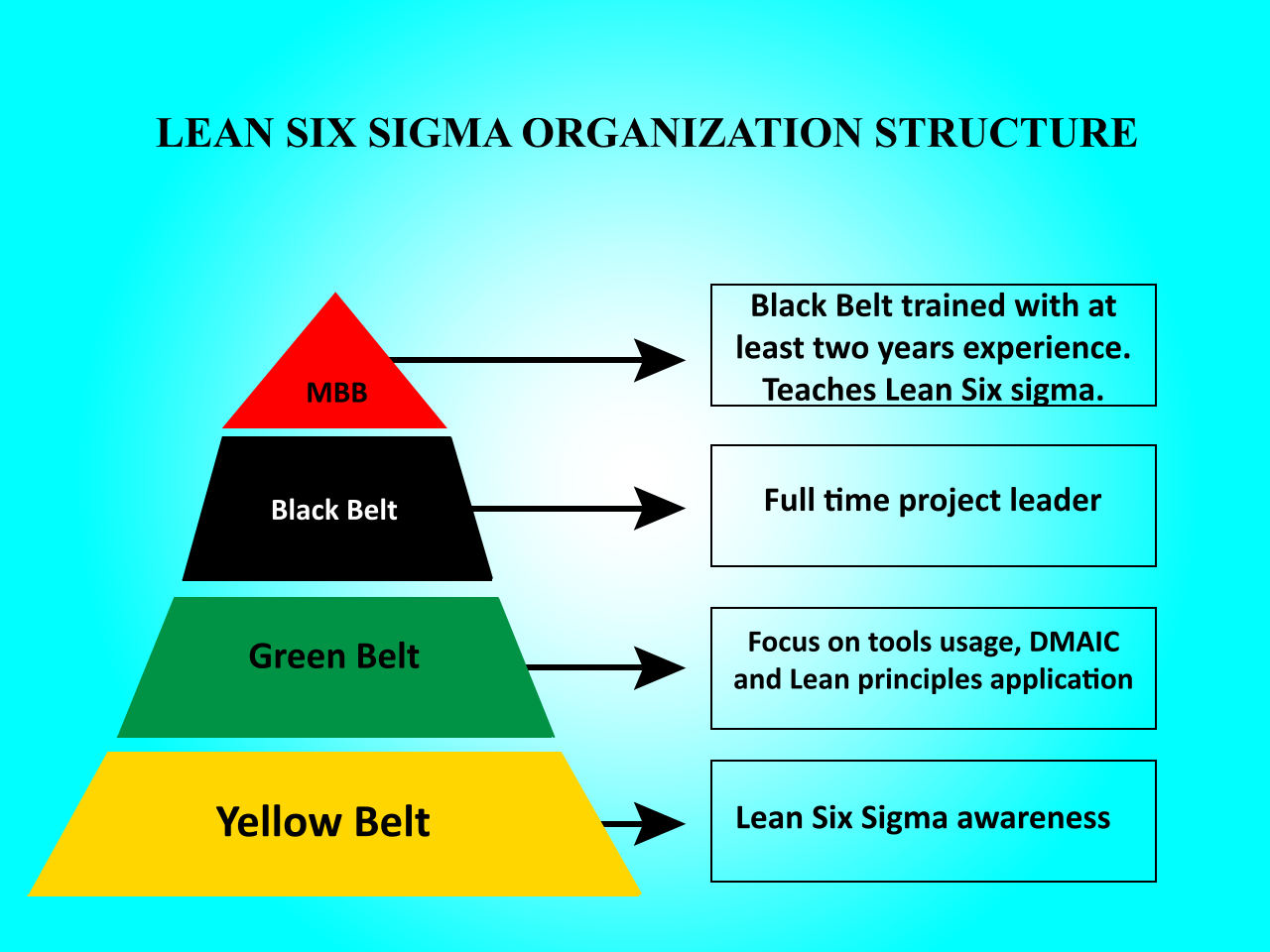
“Six Sigma” management has several levels of certification, they are: Champion, Yellow/Green Belt, Brown/Black Belt, and Master Black Belt. Each level of certification is described below.

A Six Sigma Champion is the most basic form of Six Sigma certification. A Champion understands the theory of Six Sigma management, but does not yet have the quantitative skills to function as an active Six Sigma project team member.  However, executives in Six Sigma organizations function as champions of Six Sigma projects. As champions, executives take a very active sponsorship and leadership role in conducting and implementing Six Sigma projects. A Champion should be a member of the Executive Committee, or at least a trusted direct report of a member of the Executive Committee. She or he should have enough influence to remove obstacles or provide resources without having to go higher in the organization. They work closely with the executive committee, the project leader (called a black belt) assigned to their project, and the master black belt (supervisor of black belts) overseeing their project. Champions have the following responsibilities:
Friday, 25 August 2017

Change Management and Continuous Improvement

The importance of change management to successful continuous improvement initiatives cannot be expressed enough. Anytime there is a change it needs to be managed. Otherwise the transformation initiative is bound to fail. Studies have shown that more than 60 percent of transformational initiatives fail, not due to the lack of technical or resources, but rather due to the lack of proper change management.

What is lean six sigma?

Lean Six Sigma is a continuous improvement methodology that focuses on decreasing lead time by reducing waste and variation. The reduction of lead time results in lower operating costs, higher quality, and increased customer satisfaction.

Lean Six Sigma combines Six Sigma methodology and lean methodology that can be applied in all types of organizations.

In addition, the reduction of variation makes a more predictable process, which yields fewer defects and enables you to make more accurate forecasts.

What is lean six sigma?

By utilizing Lean and Six Sigma together, you are able to achieve more than what you could by using one alone. This approach provides a wider array of improvement tools for you to draw from and increases the probability for success.

The following table gives a quick comparison between Lean and Six Sigma, note that the last element is common to both Lean and Six Sigma. They both require a change in leadership and employee mindset in order to become a successful and sustainable program.

Six Sigma Lean
Focuses on reducing variation Focuses on eliminating waste and reducing cycle time
Primary goal is to reduce defects in the process output Primary goal is to reduce non-value add or wasteful process steps
Based on statistical formula that measures the impact of root causes on the process output Based on best practices
Data Driven Observation driven
Change in mindset of leadership and employees(Six Sigma Thinking) Change in mindset of leadership and employees needed (Lean Thinking)

Thursday, 24 August 2017

5 Reasons to be Lean Six Sigma Certified

Before discussing why people should be certified, first let’s ask the question why is the Lean and Six Sigma methodology important in the first place?

The methodology is important because it provides knowledge and insight into how to make your company run as smoothly as possible while also bringing in profits. Even a basic understanding of lean principles can change and increase overall value a company provides to their customers.

Six Sigma Certified, Six Sigma


Now let’s discuss several reasons why it is be beneficial to be Lean Six Sigma Certified:

1. Career Advancement


The most common reason to have a certification is to advance your career. Having that certification provides validation to employers that you have a specific skill set. Competition for employment can be fierce and by having proof that you have knowledge and can apply lean six sigma can help set you apart.

2. Better Understanding


There are many people who have the skills and do the job as someone who is certified, but they themselves are not. Formal training and certification gives a better understanding of the topics and how to best apply the methodology. Many may not be familiar with lean or six sigma which can mean that they are not focusing on fixing the right issues because they do not know how to look for them. When teams are trained in lean, they can be more effective by focusing on the best way to better their processes.

3. Organizational Growth


Applying lean six sigma is a proven way to improve a company. If there is a large majority of people in the company who are trained and understand the methodology, it is easier to drive initiatives and new projects that are designed to improve processes. Team members who are trained have better analytical skills that can help to find causes and analyze them before acting on them. This way you approach problems and fix them more efficiently. Eliminating wastes and promoting innovation of processes continuously, can help to advance an organization and allow it to reach its goals.

4. Improved Company Culture


Lean Six Sigma is a proven methodology, yes, but it is also a culture. When this culture is implemented into a company, everyone, even if they are not all certified in lean or six sigma, can adapt to change and help in the advancement of the company. Having an enhancement and improvement culture is what will really benefit a company. Of course, culture starts from the top. Leaders within a company need to adopt a continuous improvement culture in order to promote it throughout the company. By having employees who are certified and truly understand how the principles and methods can be utilized, a continuous improvement culture will be better adopted and help increase change and innovation.

5. Standardization


Although there is no official organization that manages Lean Six Sigma certification process, the actual certification and training themselves help to provide a standard language for improvement and process management. Those who are familiar and trained in lean and six sigma speak a similar language and better understand what steps need to be taken in order to fix a process and eliminate wastes.

Tuesday, 22 August 2017

Tips for an Effective Communications Management Plan

The foundation of successful project management is the ability to communicate effectively. A large majority of a project manager’s time is spent on communications throughout all project phases. Additionally, project team members and stakeholders also share in the responsibility of communicating. Because of its importance, great care and planning must be used when developing a project’s Communications Management Plan as it sets the framework for how all communications will occur, by whom, how often, and in what methods.

Tips for an Effective Communications Management Plan

1. Determining Stakeholder Communication Requirements


Many projects fail because project managers and teams do not properly identify or manage stakeholders. Projects may have large numbers of stakeholders all with varying influence and interest. Project managers must take great care in understanding who these stakeholders are and what their requirements are for communication throughout the project. They may only want to be informed when milestones are met; or might wish to receive phone calls instead of emails; or want weekly updates until project completion. By understanding the communication requirements of every stakeholder, the project team can ensure they keep stakeholders involved with the appropriate level of detail and in the correct format (i.e. meetings, emails, phone calls).

2. Develop Guidelines for Meetings


We have all been to meetings where we sit for an hour or more and leave thinking, “I am not sure what the purpose of that meeting was but I didn’t gain anything from it”. Ineffective meetings are an unfortunate part of the business world. Every meeting should have a clear purpose and an agenda designed to meet that purpose. Project managers must make sure all meetings are structured appropriately and document these expectations in this section of the Communications Management Plan. Some guidelines include sending a detailed agenda out to all meeting participants well ahead of time, designating roles for attendees (i.e. scribe, chairperson, time keeper, etc), how meeting minutes will be published, and assigning action items.

3. Develop a Communication Matrix


Project communications can become very confusing depending on the complexity of the project. A communication matrix is a valuable tool in simplifying the intricacies of project communications. The matrix should include:
  • Communication type (i.e. team meetings or project status meetings)
  • Objective of the communication
  • Medium (email, meeting, phone call)
  • Frequency
  • Audience or attendees
  • Who is responsible for the communication
  • Any deliverables
  • Format (to include any shared drive or web site locations where data is stored)

4. Determine Communication Technologies


Often times, project teams and stakeholders are physically spread out over different areas and facilities. There is a very good chance that all of the project’s participants do not share the same technological abilities or access to the same platforms. For example, if a team publishes meeting minutes on a shared drive but others do not have access to it then it doesn’t do much good. In developing the Communications Management Plan the project manager and team must understand the technologies available to all project participants and what tools are available to communicate with them.

Monday, 21 August 2017

5 Key Parts of a Scope Management Plan

You have stakeholders, managers, users, team members and so many others all wanting you to make seemingly minor changes to your project on almost a daily basis. They all seem to suddenly be your friend and looking out for your best interest. But they don't realize that the minor changes they want are actually scope changes to the project and will affect the schedule, cost or quality of the project. The best way to manage these requests is through a robust scope management plan. While we have an excellent scope management plan template available for free download, we would also like to highlight the five components we believe are key to the plan. The following five parts are key to an effective scope management plan:

PMP, Process, Project Management

1. Approach


The approach is an important part of the Scope Management Plan because it defines how the organization will manage the scope of a project and defines various aspects of the Scope Management Plan. Some of the information that should be contained in the approach is:

◉ Scope management responsibility and authority (i.e. project manager or other designee)
◉ How the scope of the project is defined
◉ How and when the project scope is measured and verified
◉ How changes in scope are conducted
◉ Who is responsible for final acceptance of project scope (i.e. sponsor or other designee)

2. Roles and Responsibilities


Roles and responsibilities should be defined in all component plans but this is especially true in the Scope Management Plan. This is because project scope is easy to lose track of if not managed properly and things like scope creep may occur and throw the project completely off course. If roles and responsibilities are clearly defined, the project team and stakeholders are able to understand their part of ensuring that project scope is defined and remains on track throughout the project.

3. Work Breakdown Structure (WBS)


The WBS breaks project deliverables down into more manageable pieces which allows a better understand of the work to be performed. These manageable pieces, at their lowest levels, are called work packages. The intent here is that once all work packages have been completed, the scope of the project is satisfied. That is why the WBS is such a key component of the scope management plan. Since project scope can become complex and difficult to understand, the WBS is a tool used to ensure simplicity and understanding throughout the project lifecycle. The WBS may be included as part of the Scope Management Plan or as an Appendix to the plan.

4. Scope Verification


Scope verification is the process the project team uses to verify that the project deliverables meet the requirements established in the scope baseline and that there is a formal acceptance process in place for these deliverables. This is an extremely important part of scope management because scope verification must be done throughout the project’s lifecycle, not simply once at the end of the project. By verifying scope in this manner, the project team can help avoid added costs and schedule delays associated with performing work that doesn’t contribute to meeting the scope of the project.

5. Scope Control


Scope Control is the process of continually measuring the project’s progress against the scope baseline and determining any variances between the two as well as acting on those variances when necessary. Scope creep is possibly the greatest hazard to any project’s success as uncontrolled scope changes are proposed and added to the project and work begins to spiral out of control. Scope Control is a necessary part of the Scope Management Plan because well-planned scope control practices, along with a well-defined scope baseline, can prevent scope creep from occurring and improve the likelihood of a successful project.

Saturday, 19 August 2017

Mnemonics for PMP and CAPM Certifications

Does PMP Certification require memorization? PMP and CAPM aspirants use mnemonics heavily to memorize everything from Process Groups to Knowledge Areas, Process Names to ITTO’s, and much more. According to Dictionary.com, Mnemonics are something intended to assist the memory, as a verse or formula. Most of us have used mnemonics in some form or another, for exams, work, or other purposes. I still remember the mnemonic - B B Roy of Great Britain has a Very Good Wife - that I learned during my engineering degree program more than 15 years ago. It was used to recall color code sequence for resistors. And who doesn’t remember the acronym (a form of mnemonic) VIBGYOR for the seven colors of the rainbow.

PMP and CAPM Certifications

List of Mnemonics for PMP


In this post, I’m not going to share much information with you. Instead, I’m going to invite you - the readers - to share your favorite mnemonics for PMP and CAPM certification exams. I’ll start by sharing mine that I created for my PMP certification way back in 2007. I’ve kept it secret all these years (I know it sounds selfish). It is 100% original and I bet you’ll not find any reference to it preceding this post.

Mnemonic to remember 10 Project Management Knowledge Areas


I used this mnemonic to remember the names of 9 Knowledge Areas in the correct sequence. Later with PMBOK® Guide, 5th Edition, Project Stakeholder Management was added as the 10th Knowledge Area and I updated the mnemonic accordingly. The original mnemonic was:

Saw The Charming Queen Holding Cream Rose Petals

corresponding to the 9 Knowledge Areas:
  • Integration
  • Scope
  • Time
  • Cost
  • Quality
  • Human Resource
  • Communications
  • Risk
  • Procurements
With the addition of Project Stakeholder Management in PMBOK Guide, 5th Ed, I updated the mnemonic to:

Saw The Charming Queen Holding Cream Rose Petals Sexily
  • Integration
  • Scope
  • Time
  • Cost
  • Quality
  • Human Resource
  • Communications
  • Risk
  • Procurements
  • Stakeholder

Mnemonic to remember SPI, CPI, SV, and CV Formulas


People find it hard to remember whether EV goes in the numerator or denominator for SPI / CPI formulae, and whether it comes first or later in the SV / CV formulae. The formulae are:

SPI = EV / PV
CPI = EV / AC
SV  = EV - PV
CV  = EV - AC

The simple mnemonic that I devised to remember it to mentally associate EV with EVerest, yes Mount EVerest, which is the highest mountain in the world. EVerest is always on top (numerator) in SPI / CPI formulae and comes first in the SV / CV formulae.

Friday, 11 August 2017

Professionalise Project Management

The following is an extract from my new book ‘How to get Fired at the C-Level: Why mismanaging change is the biggest risk of all’ in association with my friends at Tailwind Project Solutions – the extracts follow a series of 5 Challenges that I think every organisation should consider, and consider very carefully – this is the final of the five challenges: